Lowering Your Pool's Electricity Bill Without Sacrificing Comfort

At the end of the summer season, the electricity bill tells a story. Running a pool pump 8 to 12 hours a day, heating the water, running a robotic cleaner — it adds up faster than most people expect. For an average residential pool, energy costs can represent a significant chunk of the total annual maintenance budget.
The good news is that a large portion of that consumption is avoidable — not by cutting corners on water quality or comfort, but by running things smarter. Most pools are over-filtered, over-heated, and under-covered. Fixing that costs nothing except a bit of attention.
In Brief
A pool's energy consumption is dominated by three things: the filtration pump, the heating system, and water loss through evaporation. Optimizing pump runtime based on actual water temperature (rather than running it on a fixed schedule), using a pool cover consistently, and adjusting heating habits are the three highest-impact changes most pool owners can make. Together, they can reduce energy costs by 40–60% without any noticeable impact on water quality or swimming comfort.
The Pump Is Your Biggest Consumer — and the Easiest to Optimize
The filtration pump typically accounts for 50–70% of a pool's total electricity consumption. It's also where the biggest savings are hiding.
Most pool owners run their pump on a fixed daily schedule — 8 hours in spring, 10 in summer — regardless of what's actually happening with the water. That's a reasonable starting point, but it's not optimized. Filtration need is directly tied to water temperature: warm water breeds bacteria and algae faster, so it needs more filtration. Cool water in early spring or late autumn needs much less.
A simple rule of thumb used by pool professionals: divide the water temperature (in °C) by 2 to get the recommended daily filtration hours. At 28°C, that's 14 hours. At 18°C, it's 9 hours. At 14°C, it's 7 hours. This single adjustment, applied dynamically throughout the season, can meaningfully reduce pump runtime during the cooler months without ever compromising water quality.
Beyond runtime, when you run the pump matters too. Running it during off-peak electricity hours (typically at night or early morning) can reduce the cost per kWh significantly if you're on a time-of-use tariff. Most programmable timers cost less than €20 and pay for themselves within a season.
If you're replacing your pump or motor, a variable speed pump is the most impactful single investment for long-term savings. Variable speed pumps can run at lower speeds for routine filtration and ramp up only when needed. At half speed, a pump uses roughly one-eighth of the energy of the same pump running at full speed — the relationship is cubic, not linear. The payback period is typically 2–4 years, after which the savings are pure.
A Pool Cover Is the Single Most Effective Energy Tool You Have
This is the point that surprises most pool owners: a pool cover doesn't just keep debris out. It's an energy device.
Here's why. A significant portion of pool heating energy is lost not through the water itself, but through evaporation at the surface. Every liter of water that evaporates takes energy with it — energy your heater spent raising that water to temperature. On a warm, breezy day, an uncovered pool can lose the equivalent of several degrees of heating through evaporation alone.
A quality thermal cover (also called a bubble cover or solar cover) reduces evaporation by up to 95%. It also adds a small amount of solar heating during the day and retains heat overnight. The combined effect can reduce heating costs by 50–70% in a covered pool versus an uncovered one.
The discipline of covering the pool whenever it's not in use — including overnight and on windy days — is the single highest-return habit a pool owner can develop. It takes 2 minutes. The savings over a season are substantial.
Heating: Adjust Your Target Temperature
Pool heaters and heat pumps are efficient, but they're working against constant heat loss. Every degree you raise the target temperature increases energy consumption — roughly 10–15% more per additional degree in a heat pump, more in a traditional electric heater.
Most people find 26–28°C perfectly comfortable for swimming. Keeping the target at 26°C rather than 28°C doesn't feel dramatically different in the water, but it represents a meaningful reduction in heating energy over the course of a season.
A few additional habits make a significant difference:
Lower the temperature during periods of non-use. If you're away for a week, there's no reason to maintain 27°C. Dropping the target to 20°C while you're gone and ramping it back up 24–48 hours before you return maintains water balance without burning energy unnecessarily.
Use a heat pump rather than an electric resistance heater if you have the choice. Heat pumps move heat from the air into the water rather than generating it directly — they're typically 3–5x more efficient than resistance heaters for the same output.
Time your heating cycles. Running the heat pump during the warmest part of the day (when outside air temperature is highest) improves efficiency, since heat pumps extract heat from ambient air and work harder — and use more energy — in cold air.
Small Habits That Add Up
Beyond the big three, a handful of smaller practices contribute meaningfully over a full season:
Keep your filter clean. A clogged or dirty filter forces the pump to work harder to maintain the same flow rate. Backwashing or cleaning at the right time — not too early, not too late — keeps the pump running efficiently.
Check for and fix leaks. A slow leak means constantly adding fresh cold water, which your heater then needs to bring back up to temperature. It also affects chemistry stability. If your water level drops faster than evaporation alone explains, investigate.
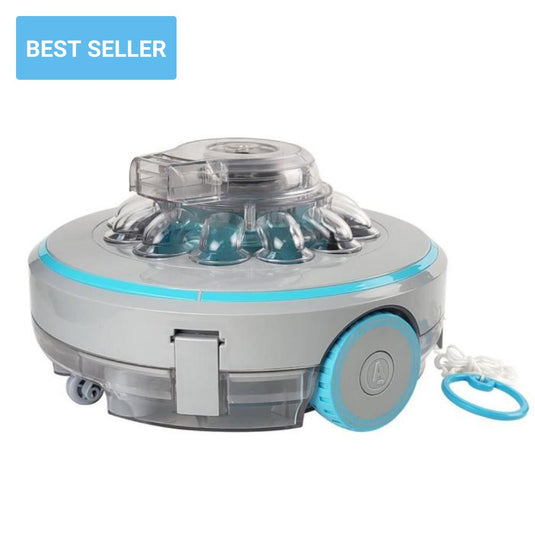
Use your robotic cleaner off-peak. If you're on a time-of-use electricity tariff, scheduling your robot during cheap-rate hours is a simple, no-effort saving.
Don't over-treat the water. Over-dosing chemicals doesn't just cost money directly — it can affect water balance in ways that require corrective treatments, which in turn can affect filtration needs. Accurate, measured dosing based on real water data is more efficient than reactive over-correction.
Monitoring as a Foundation for Efficiency
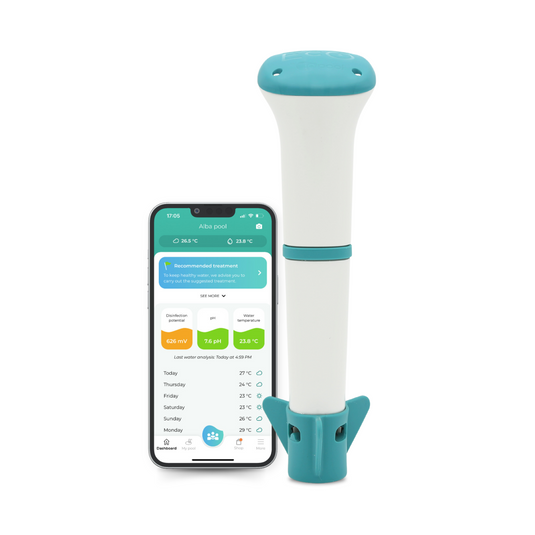
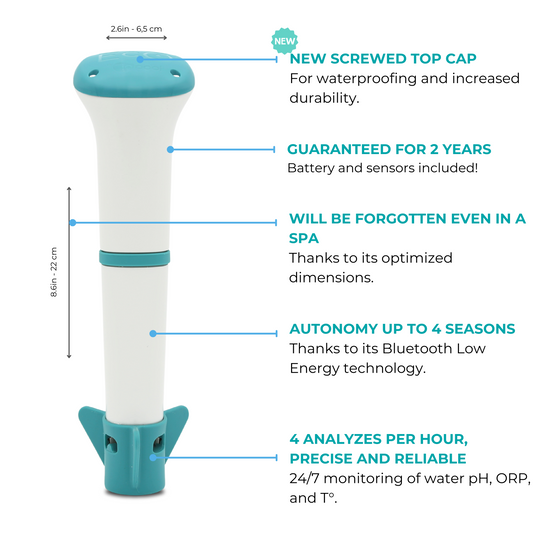
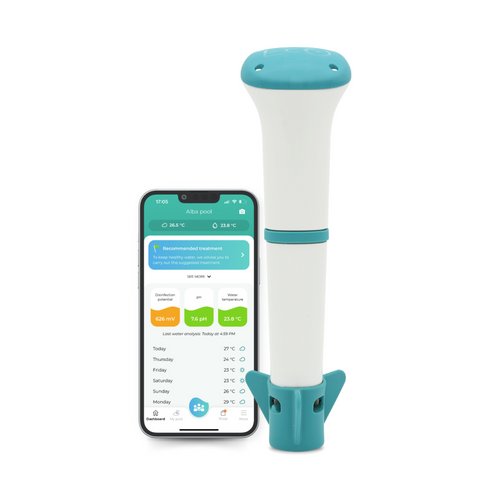
Saving energy in a pool isn't about doing less — it's about doing the right things at the right time. That's hard to do without data. Knowing your water temperature in real time lets you adjust filtration runtime dynamically. Knowing your ORP and pH means you're dosing chemicals based on actual need rather than habit.
A connected pool analyzer gives you exactly that visibility — and turns energy optimization from guesswork into a systematic practice.
FAQ
How many hours should I run my pool pump per day? A reliable rule of thumb is to divide the water temperature (°C) by 2. At 26°C, that's 13 hours. At 16°C, it's 8 hours. Adjust up slightly in hot weather or after heavy use, down during cooler, quieter periods.
Does running the pump at night save money? It can, if you're on a time-of-use electricity tariff with cheaper overnight rates. The water quality outcome is the same regardless of when you filter — so shifting runtime to off-peak hours is a straightforward saving.
Is a variable speed pump worth the investment? For most pools used regularly, yes. The energy savings typically offset the higher purchase cost within 2–4 years, and the pump tends to run more quietly and last longer than single-speed equivalents.
How much can a pool cover really save? Studies consistently show 50–70% reductions in heating costs for covered versus uncovered pools. The payback on a quality thermal cover is often less than one season.
My heat pump seems to use more energy on cold days. Is that normal? Yes. Heat pumps extract heat from ambient air — the colder the air, the harder they work and the less efficient they become. Most residential pool heat pumps operate efficiently down to around 10–12°C outside air temperature, below which their efficiency drops significantly.