Cloudy or Milky Pool Water: Exact Causes and How to Fix It

Short answer: Cloudy or milky pool water is almost always caused by one of five things: high pH causing calcium precipitation, insufficient filtration, chlorine that's too low or too high, fine particles left in suspension after a treatment, or excessive Calcium Hardness (CH). Diagnosis starts with observing exactly what the water looks like, then testing parameters in the right order. This guide gives you the visual diagnosis table, the correction protocol, and the most common special cases.
Is It Safe to Swim in Cloudy Water?
No. Cloudy water isn't just unappealing — it can pose a real health risk. Water where you can't see the bottom is considered unsafe for swimming. Turbidity can mask suspended bacteria, microscopic algae, or chemical imbalances that irritate skin and eyes. It can also hide underwater hazards and distort depth perception.
Simple rule: if you can't clearly see the bottom of the pool from the edge, don't swim until the water is clear again.
Visual Diagnosis Table: Identify the Cause by How the Water Looks
The visual appearance of your water is the first clue. Before testing anything, take a close look.
| What the water looks like | Likely cause | First parameter to check |
|---|---|---|
| Milky white, fine white particles in suspension | Calcium precipitation (high pH and/or high CH) | pH, then Calcium Hardness |
| Hazy grey, bottom visible but blurry | Insufficient filtration or dirty filter | Filter run time and condition |
| Cloudy greenish tint | Algae in suspension (low or neutralized chlorine) | pH, then free chlorine, then CYA |
| Milky after shock treatment | Dead algae and bacteria in suspension | Filtration and clarifier/flocculant |
| Milky immediately after adding pH increaser | Calcium precipitation from chemical reaction (high TA) | Total Alkalinity, then Calcium Hardness |
| Cloudy after heavy rain or storm | Organic matter influx, diluted chlorine | pH, free chlorine, phosphates |
| Cloudy after heavy bather load | Organic overload, free chlorine drop | Free chlorine, then combined chlorine |
Cause #1: High pH and Calcium Precipitation
This is the most common cause of milky or whitish water. When pH exceeds 7.8, dissolved calcium in the water precipitates into microscopic solid particles. These particles stay in suspension and give the water its characteristic milky appearance.
| Parameter | Observed Value | Trigger Threshold |
|---|---|---|
| pH | Above 7.8 | Calcium precipitation possible from 7.6 if CH is high |
| Calcium Hardness (CH) | Above 400 ppm | Strongly accelerates calcium precipitation |
How to fix it:
- Test Total Alkalinity first: if it's above 120 ppm, correct it before touching pH
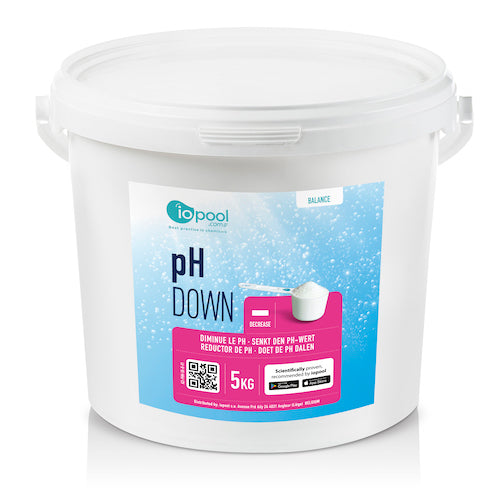
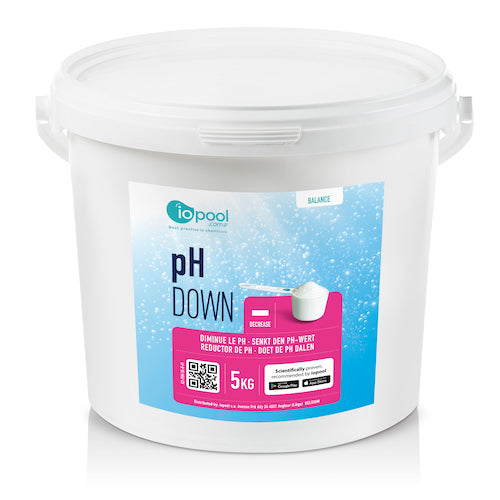
- Lower pH to 7.2 – 7.4 using pH decreaser (dry acid or muriatic acid)
- Run the filter continuously for 24 to 48 hours
- If water remains cloudy, use a clarifier or flocculant to clump the calcium particles
- If CH exceeds 400 ppm, use a scale inhibitor as a preventive treatment
Cause #2: Insufficient or Clogged Filtration
Filtration accounts for roughly 80% of water clarity. A filter that doesn't run long enough, a clogged filter, or an undersized pump leaves fine particles in suspension instead of capturing them.
| Filtration Problem | Symptom | Fix |
|---|---|---|
| Insufficient run time | Cloudy in the evening, clearer in the morning | Apply the rule: water temp (°F) ÷ 2 = daily filter hours |
| Clogged sand filter | High pressure gauge reading, persistent cloudy water | Deep backwash; check sand condition (replace every 5 years) |
| Blocked cartridge filter | Low flow rate, cloudy water | Clean cartridge with degreaser solution; replace if worn |
| Incorrectly aimed return jets | Stagnant zones, locally cloudy water | Redirect jets to circulate the entire pool |
Tip: after backwashing, run the filter continuously for at least 24 hours. If the water remains cloudy, add a clarifier at the start of the cycle.
Cause #3: Chlorine Imbalance
Low chlorine allows bacteria and microscopic algae to multiply, making the water cloudy. Very high chlorine combined with elevated pH can also create precipitates that cloud the water.
| Situation | Free Chlorine Level | Effect on Water | Action |
|---|---|---|---|
| Chlorine too low | Below 0.5 ppm | Greenish or grey cloudy water, bacteria and algae | Fix pH first, then shock with unstabilized chlorine |
| Chlorine blocked by high pH | Normal (1 – 3 ppm) but inactive | Cloudy water despite a normal chlorine reading | Correct pH before adding any more chlorine |
| Overdose after shock treatment | Above 10 ppm | Temporarily cloudy or opaque water | Run filter, expose to sun, retest after 24 hours |
Cause #4: High Calcium Hardness
Calcium Hardness above 400 ppm indicates very hard water, rich in calcium and magnesium. This water is prone to calcium precipitation, especially when pH or water temperature rises. The result is a white, milky appearance, sometimes with visible white deposits on walls and equipment.
| CH Level | Interpretation | Action |
|---|---|---|
| Below 200 ppm | Too soft, corrosive water | Add calcium chloride |
| 200 – 400 ppm | Ideal range | No action needed |
| 400 – 600 ppm | Hard water, precipitation risk | Preventive scale inhibitor, monitor pH closely |
| Above 600 ppm | Very hard water, precipitation almost certain | Partial drain and refill with softer water |
Cause #5: Fine Particles After Treatment
After a chlorine or non-chlorine shock, killed algae and bacteria remain in suspension as microscopic particles. Normal filtration can't always remove them on its own. This is the most common cause of milky water that appears after a treatment that seemed to be going well.
How to fix it:
- Use a pool clarifier (compatible with sand and cartridge filters): it clumps small particles into larger masses the filter can capture
- Or use liquid flocculant (sand filters only): particles sink to the bottom and are vacuumed out manually
- Run the filter continuously for 24 to 48 hours after treatment
- Backwash the filter after the clarifier treatment
Clarifier vs. flocculant: a clarifier works with all filter types and causes particles to collect on the filter media. Liquid flocculant drops particles to the pool floor for manual vacuuming — never use flocculant with a cartridge filter, as it will clog it immediately.
Special Case: Cloudy Water Right After Adding pH Increaser
This is one of the most commonly reported issues on pool forums. You add soda ash (sodium carbonate) to raise a low pH, and within seconds the water turns white or milky. Sometimes a white deposit forms on the floor.
What's happening: soda ash reacts with dissolved calcium in the water to form calcium carbonate (scale), which is insoluble and precipitates immediately. This is a normal chemical reaction when Total Alkalinity or Calcium Hardness is too high.
How to prevent and fix it:
- Test Total Alkalinity before adding soda ash: if it's above 120 ppm, don't use soda ash to raise pH
- Test Calcium Hardness: if it's above 400 ppm combined with high TA, precipitation is almost certain
- Pre-dilute soda ash in a large bucket of water before pouring it slowly near the return jets
- If the reaction has already occurred: run the filter for 48 hours, add a clarifier, vacuum the white deposit from the floor
- Correct Total Alkalinity with muriatic acid before any further pH adjustments
Full Protocol to Get Clear Water Back
Step 1: Identify the Cause
Use the visual diagnosis table at the top of this article. Observe the water's appearance, then test in this order: pH, Total Alkalinity, free chlorine, Calcium Hardness, phosphates.
Step 2: Correct the Chemistry
- TA out of range → correct first
- pH out of range → correct after TA
- Chlorine too low → shock after pH is corrected
- CH too high → scale inhibitor or partial drain and refill
Step 3: Optimize Filtration
- Backwash the filter
- Run continuously for 24 to 48 hours
- Check and redirect return jets for full pool circulation
Step 4: Clarifier Treatment If Needed
- Liquid clarifier (all filter types): add in the evening, run filter continuously overnight
- Liquid flocculant (sand filters only): switch to recirculate mode overnight, vacuum to waste the next morning
What to Expect
| Timeframe | Normal Result |
|---|---|
| 12 to 24 hours | Noticeable improvement in clarity |
| 24 to 48 hours | Water significantly clearer |
| 48 to 72 hours | Water fully clear |
Still cloudy after 72 hours? A parameter wasn't correctly identified or corrected. Go back to Step 1 and test everything again, including CH and phosphates.
FAQ
Why is my pool water cloudy even though my chlorine level is correct?
Correct chlorine doesn't guarantee clear water. Cloudy water with a normal chlorine reading is usually caused by high pH precipitating calcium, high Calcium Hardness, insufficient filtration, or fine particles the filter can't capture. Test pH, Total Alkalinity, and Calcium Hardness before drawing any conclusions.
What's the difference between cloudy and green water?
Green water signals active algae growth, almost always from insufficient or inactive chlorine. Whitish or grey cloudy water without a green tint is more commonly linked to calcium precipitation, filtration problems, or fine particles in suspension. The two can overlap: greenish and cloudy water often combines algae with a chemical imbalance.
Clarifier or flocculant: which should I use?
A clarifier works with all filter types (sand, cartridge, glass media). It clumps small particles together so the filter can capture them. Liquid flocculant is for sand filters only: it drops particles to the pool floor for manual vacuuming. Never use flocculant with a cartridge filter — it will clog it immediately.
My pool is only cloudy in the morning and clears up by midday — why?
Morning-only cloudiness that clears through the day usually points to insufficient overnight filtration. When temperature drops at night, particles redistribute in the water. If the filter doesn't run long enough, they stay in suspension through the morning. Check that your filter schedule covers the recommended run time (water temp in °F ÷ 2) across a full 24-hour period.
Can I use a clarifier and flocculant at the same time?
No. They're two different approaches to the same problem — using them together can cause undesirable reactions and overload your filter. Choose one based on your filter type, let it work fully, then assess the result before considering a second treatment.
My pool goes cloudy after every rainstorm — is that normal?
Yes, it's common. Rain introduces organic matter and phosphates, dilutes chlorine, and can destabilize pH. Prevention: test and adjust parameters within 24 hours after every storm. If your pool clouds consistently after rain, also check phosphate levels — runoff water is a major source of pool phosphates.
Can a connected pool analyzer help prevent cloudy water?
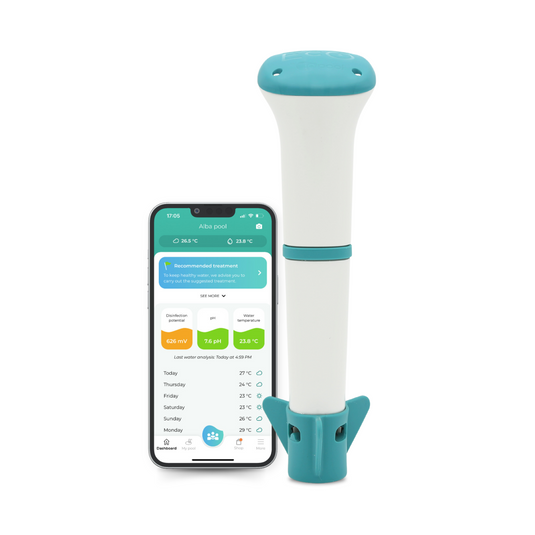
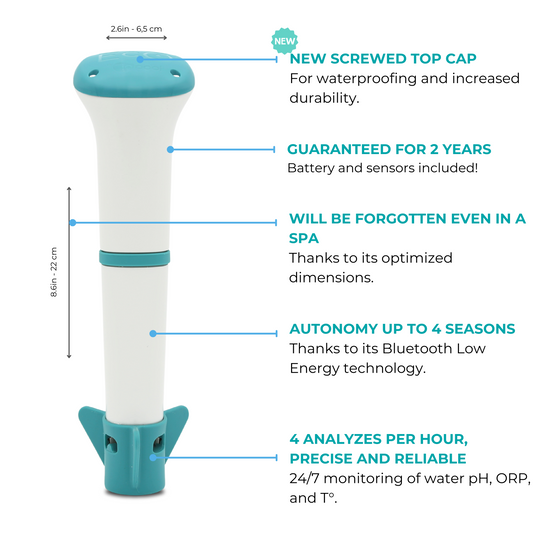
Yes, indirectly. Most cloudy water episodes stem from undetected pH drift or a free chlorine drop. The iopool Eco Start monitors pH and ORP continuously and alerts you the moment a parameter drifts — so you can intervene on a minor imbalance before it becomes a visible problem. This is especially valuable after storms or heavy swim sessions, when deterioration can happen very quickly.
Water still cloudy and the cause isn't clear? Share your readings in the comments (pH, TA, CH, free chlorine, filter type, and pool volume) and our team will help you identify the exact cause.