How to Balance Pool Stabilizer (CYA): Target Levels, Corrections, and Practical Tips

In Brief
Pool stabilizer — also called cyanuric acid or CYA — protects chlorine from UV degradation. Without it, up to 90% of your chlorine can disappear in a single sunny day. The ideal range is 30–50 ppm for a standard chlorine pool, and 60–80 ppm for a saltwater pool. Above 100 ppm, chlorine becomes ineffective even when present. Below 30 ppm, you're burning through product unnecessarily. Here's how to measure it, adjust it, and keep it in balance over time.
Why Stabilizer Is Essential in an Outdoor Pool
It only takes 17 minutes of sun exposure to destroy half the chlorine in your pool. Without protection, a sunny day can wipe out up to 90% of your free chlorine — even if you just added some.
Stabilizer acts like sunscreen for your chlorine. It binds to active chlorine molecules and shields them from UV degradation. The bond is temporary and reversible: chlorine is gradually released to keep disinfecting, but at a much slower rate than it would break down without stabilizer.
Without it, your pool burns through chlorine fast, quickly creating ideal conditions for bacteria and algae. With the right stabilizer level, a weekly treatment is enough in most cases to maintain healthy water.
Indoor pools: they receive no direct UV exposure and need little to no stabilizer — unless they receive direct natural light and you're seeing an unexplained drop in chlorine levels.
What Stabilizer Level Should You Aim For?
Start by measuring the stabilizer already present in your water — never add product without testing first. Multi-parameter test strips give a quick indication; a liquid colorimetric kit gives a more precise reading.
| Level | Status |
|---|---|
| Below 30 ppm | Insufficient — chlorine degrades too quickly |
| 30–50 ppm | Ideal — standard chlorine pool |
| Up to 70 ppm | Acceptable in some conditions (heat, heavy use) |
| 60–80 ppm | Target range for saltwater pools |
| Above 100 ppm | Over-stabilization — correction required |
The 7.5% rule: your free chlorine level should equal roughly 7.5% of your stabilizer level. Formula: stabilizer level × 0.075 = target free chlorine. If your stabilizer is at 50 ppm, aim for around 3.75 ppm of free chlorine — within the standard 2–4 ppm range.
Saltwater pools need a higher stabilizer range because the electrolysis system continuously produces chlorine that degrades quickly under UV.
How Stabilizer Builds Up in Your Pool
This is often where problems start — silently, over months and seasons.
Pure stabilizer (granules or liquid): added once at the start of the season. It doesn't evaporate, doesn't break down, and only decreases when the water is diluted.
Stabilized chlorine tablets (trichlor or dichlor): the most common — and least visible — source. Every tablet adds both chlorine and stabilizer. With 450g of dichlor in 37,000 liters of water, you're already adding 6–7 ppm of stabilizer. Repeat that weekly, and the level climbs steadily throughout the season. Carry it over to next season without a partial drain, and you'll start the year already in the danger zone.
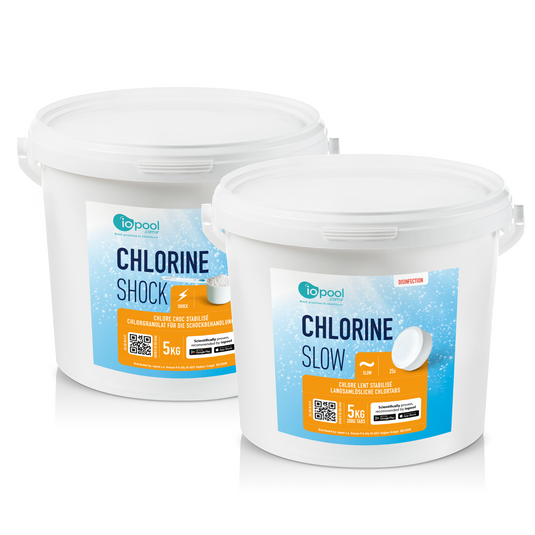
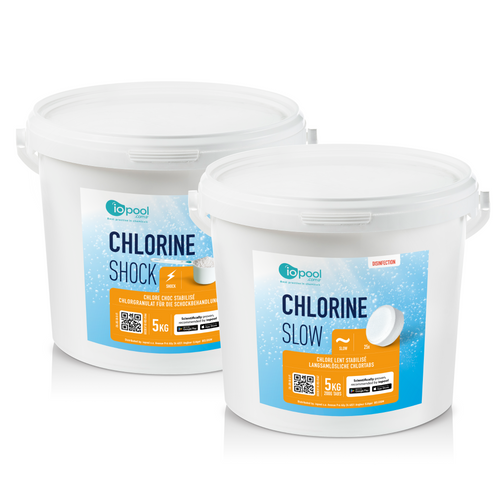
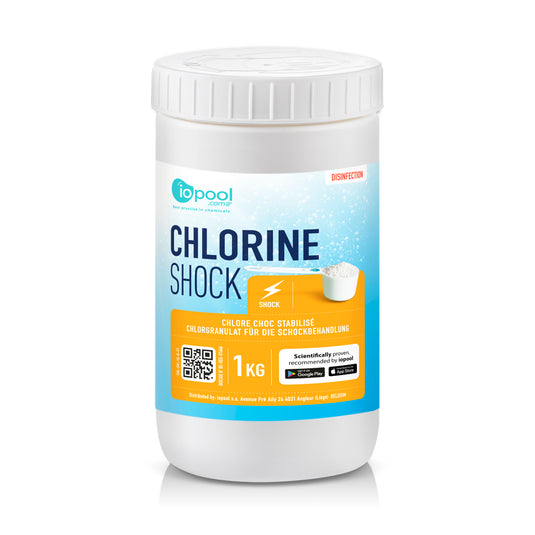
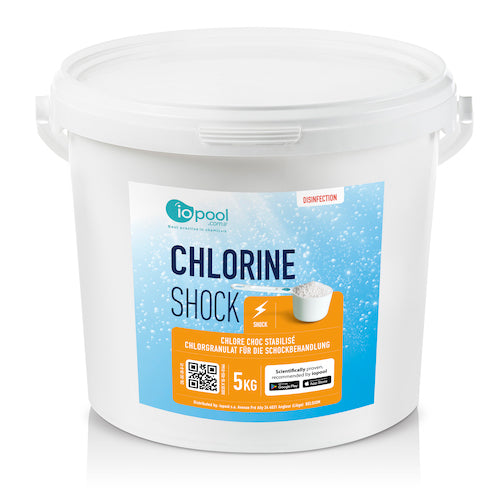
Chlorine shock and liquid chlorine are generally unstabilized — they don't add extra CYA. Both are good choices when you need to disinfect without pushing your stabilizer level higher.
Key property: stabilizer doesn't disappear on its own. Only dilution — partial draining, heavy rain, overflow — brings the concentration down. Monitor it throughout the season, not just at opening.
Stabilizer Too High: What to Do
Above 100 ppm, you enter over-stabilization. Chlorine is present, your tester shows a normal reading — but it's no longer being released effectively enough to disinfect. Algae and bacteria can develop despite appearances. It's a misleading situation that directly affects swimmer health.
Option 1: Partial Drain (Recommended)
The simplest and most reliable method.
- Draw water from the bottom of the pool — stabilizer tends to concentrate there
- Drain 10–30% of the total volume depending on how far over the threshold you are
- Refill with fresh water
- Run the pump for several hours to mix thoroughly
- Retest before resuming normal treatments — repeat if needed
Watch your filter: stabilizer can linger in the filter media. If levels were very high, backwash or replace the media.
Option 2: Reverse Osmosis Filter
Specialized filters can capture stabilizer without draining the pool. More expensive, but useful for in-ground pools without a suitable drain system or where water recovery is a concern.
What About CYA Reducers?
Products marketed as "stabilizer reducers" or "CYA reducers" exist, but their effectiveness is highly variable and rarely guaranteed. They're natural-based, slow-acting — sometimes taking a week or more to show results. At iopool, we sold this type of product before discontinuing it: customer results were too inconsistent to recommend it with confidence. Partial draining remains by far the most reliable solution.
How to Add Stabilizer Correctly
If your level is below 30 ppm and you need to add pure stabilizer:
- Stabilizer is an acid: always wear gloves and protective goggles
- Liner or fiberglass pools: dissolve the stabilizer in a bucket of warm water first, then pour around the edges — never directly onto the liner
- Concrete pools: you can pour it directly into the water, but disperse it with a brush since it tends to settle on the floor
- Dosage reference: approximately 370g of stabilizer raises the level by 10 ppm in a 45 m³ pool
- After adding: run the pump for at least 24 hours before retesting, and wait until the product is fully dissolved before swimming
With a connected analyzer like the iopool EcO probe, you can monitor your stabilizer-to-chlorine balance continuously and get notified before levels drift out of range.
FAQ
How often should you add stabilizer? Once per season is generally enough if you're using stabilized chlorine tablets. Stabilizer doesn't evaporate or break down — levels only drop through dilution. Test at opening, mid-season, and after any significant water addition.
Can you swim right after adding stabilizer? Wait at least 30 minutes and ensure the product is fully dissolved. Always follow the manufacturer's instructions on the label.
Should you use stabilizer in an indoor pool? No, except in rare cases. Stabilizer protects chlorine from solar UV, which is absent in most indoor pools. If your indoor pool receives direct natural light and you're seeing abnormally high chlorine consumption, a low stabilizer level can be considered.
Can baking soda replace pool stabilizer? No. Baking soda (also called TAC+ or Alka+) raises total alkalinity — it has no effect on chlorine stability. These two products serve entirely different purposes and are not interchangeable.
Why is the target range different for saltwater pools? A saltwater pool's electrolysis system produces chlorine continuously, which means continuous exposure to UV degradation. A slightly higher stabilizer level (60–80 ppm) compensates for this and keeps the system efficient without overproducing chlorine.