Saltwater Pool and Salt Chlorine Generator: The Complete Guide Before You Decide

Short answer: A "saltwater pool" produces chlorine through electrolysis — it's not an alternative to chlorine, it's a way of producing it automatically from the salt dissolved in the water. The real advantages are swimming comfort (fewer chloramines), reduced chemical purchases, and partial automation of sanitation. The real drawbacks are the upfront cost ($800 to $2,500 for the unit), the systematic pH rise that electrolysis generates, accelerated corrosion of metal components, and regular cell maintenance. This guide covers everything you need to know before deciding whether to go saltwater — or not.
How Does a Salt Chlorine Generator Work?
A salt chlorine generator (SCG) is a device installed on the pool's filtration line. When salt-laden water (sodium chloride) passes through the electrolytic cell, an electric current breaks down the salt into active chlorine (hypochlorous acid). This chlorine sanitizes the water as it circulates, then gradually recombines back into salt through UV exposure and swimmer activity. The cycle begins again with each pass through the cell.
| Step | What Happens |
|---|---|
| 1. Initial fill | Dissolve salt to reach 2,700–3,500 ppm in the pool (roughly 200–400 lbs for a 13,000-gallon pool) |
| 2. Filter running | Salt-laden water circulates through the electrolytic cell |
| 3. Electrolysis | Electric current splits salt into active chlorine (sodium hypochlorite) |
| 4. Sanitation | Chlorine sanitizes the water as it circulates through the pool |
| 5. Recombination | After acting, chlorine converts back into salt — the cycle restarts |
Salt concentration: 2,700 to 3,500 ppm in a pool, versus 35,000 ppm in the ocean. The water has a very mild, barely perceptible salinity — no discomfort for swimmers or eyes.
The Big Misconception: A Saltwater Pool Still Contains Chlorine
This is the most important thing to understand before making any decision. A "saltwater pool" is not a chlorine-free pool. The salt chlorine generator produces chlorine from salt — that's its sole function. The difference from a traditional chlorine pool isn't the sanitizer (it's the same) but how it gets into the water.
A saltwater pool is a chlorine pool where the chlorine is produced automatically on-site rather than added manually. The parameters to monitor remain exactly the same: pH, free chlorine, Total Alkalinity, CYA, phosphates.
What changes in practice: fewer chlorine purchases, continuous and steady production rather than periodic additions, and generally more comfortable water because chloramines (responsible for irritation) break down faster thanks to the constant supply of fresh chlorine.
The Real Advantages
| Advantage | What It Means in Practice |
|---|---|
| Superior swimming comfort | Fewer chloramines (responsible for odors and irritation) thanks to continuous fresh chlorine production. Water feels softer on skin and eyes. |
| Automated sanitation | The SCG produces chlorine continuously while the filter runs, eliminating daily manual chemical additions. |
| Reduced chlorine purchases | Salt recombines in a cycle: once the pool is filled, very little additional salt is needed (only top-ups after partial drains or heavy rain). |
| No CYA accumulation risk | Chlorine produced by electrolysis is unstabilized — no risk of cyanuric acid buildup season after season. |
| Low annual operating costs | Salt is inexpensive. The bulk of the investment is concentrated at purchase and installation. |
The Drawbacks to Know Before Buying
| Drawback | What It Means | How to Mitigate It |
|---|---|---|
| Systematic pH rise | Chlorine production releases sodium hydroxide (lye), a strongly alkaline byproduct, causing pH to climb constantly. Without management, pH quickly exceeds 7.8 and chlorine becomes ineffective. | Pair the SCG with an automatic pH controller, or correct pH manually very frequently. |
| High upfront cost | SCG unit alone: $800 to $2,500. With integrated pH controller: $1,500 to $4,000. Professional installation is recommended. | Calculate long-term: savings on chemicals typically offset the initial investment within 3 to 5 years. |
| Cell replacement | Electrodes wear out and scale up over time. Lifespan: 4 to 7 years depending on model and maintenance quality. Replacement cost: $200 to $900. | Choose a self-cleaning (reverse polarity) SCG. Maintain the cell regularly. |
| Accelerated corrosion of metal components | Salt attacks pool ladders, metal coping, and some heaters and pumps not rated for salt water. | Verify compatibility of all equipment before installation. Prefer 316L stainless steel or composite materials. |
| Ineffective in cold water | Below 60°F, water conductivity is insufficient and the SCG stops producing chlorine properly. Forcing operation in cold water prematurely wears the electrodes. | Shut down the SCG when water drops below 60°F and switch to conventional chlorine for transition periods. |
| Maintenance is not zero | Contrary to popular belief, a saltwater pool requires regular monitoring of pH, salt level, and cell condition. It is not a zero-maintenance solution. | Schedule regular checks. Use a connected analyzer for daily pH and ORP monitoring. |
Parameters to Monitor in a Saltwater Pool
A saltwater pool requires monitoring all the usual parameters, plus two specific to electrolytic treatment.
| Parameter | Ideal Range | Saltwater Pool Specifics | Test Frequency |
|---|---|---|---|
| pH | 7.2 – 7.4 | Rises constantly due to electrolysis. The most critical parameter in a saltwater pool. | Daily to twice daily without an auto pH controller |
| Free Chlorine | 0.5 – 1.5 ppm | Lower than traditional chlorine pools because it's produced continuously. Chlorine that's too high signals SCG overdosing. | 2 to 3 times/week |
| Total Alkalinity (TA) | 80 – 120 ppm | Same as traditional chlorine pools | Once a month |
| Salt Level | 2,700 – 3,500 ppm (per manufacturer) | Salt-specific parameter: too much salt accelerates corrosion. Too little means insufficient chlorine production. | Start of season and after partial drain |
| ORP (Redox Potential) | 650 – 750 mV | The most reliable indicator of actual sanitation effectiveness. Crucial in saltwater pools to compensate for pH variability. | Continuously (connected analyzer) |
| Phosphates | Below 100 ppb | Same as traditional chlorine pools | Once a month |
| Calcium Hardness (CH) | 200 – 400 ppm | Very hard water accelerates cell scaling — a major cause of premature cell failure | Once a month |
Salt Chlorine Generator Maintenance: What to Do
Electrolytic Cell Maintenance
The cell is the core component of the SCG. It must be inspected and cleaned regularly to maintain its output.
- Inspection frequency: once a month during the swim season
- Signs of scaling: white calcium deposits on the plates, drop in chlorine production despite correct salt level
- Cleaning: soak the cell in a dilute muriatic acid solution (1 part acid to 10 parts water) for 10 to 20 minutes. Rinse thoroughly before reinstalling.
- Self-cleaning (reverse polarity) models: the cell reverses polarity automatically at set intervals to dislodge calcium deposits. Recommended for hard water areas and vacation homes.
Winter Shutdown
- Turn off the SCG when water temperature drops below 60°F
- Remove and rinse the cell before winterizing
- Store the cell in a frost-free location
- Switch to conventional chlorine (tablets or liquid) for transition periods if the pool stays filled
Saltwater vs. Traditional Chlorine Pool: Comparison Table
| Criterion | Traditional Chlorine Pool | Saltwater Pool (SCG) |
|---|---|---|
| Sanitizer type | Chlorine added manually (tablets, liquid, granules) | Chlorine produced automatically by salt electrolysis |
| Installation cost | Low (filter and pump only) | High ($800 to $4,000 for SCG and controller) |
| Annual operating cost | $200 to $500 in chemicals | $50 to $120 in salt plus cell maintenance |
| Swimming comfort | Variable, depends on chloramine management | Superior: fewer chloramines, softer water feel |
| pH management | pH rises after certain chemical additions | pH rises constantly and systematically |
| CYA buildup risk | Yes (with trichlor tablets) | No (chlorine is unstabilized) |
| Equipment corrosion | Low | Higher: verify compatibility of all equipment |
| Automation level | Low (manual additions) | High (automatic production) |
| Parameters to monitor | pH, chlorine, TA, CYA, phosphates | Same plus salt level and cell condition |
The Role of a Connected Analyzer in a Saltwater Pool
Saltwater pools have a common paradox: people install them to reduce manual intervention, but electrolysis constantly drives pH upward — requiring more frequent monitoring than a traditional chlorine pool. Without an automatic pH controller, a poorly monitored saltwater pool can easily see pH exceed 8.0, making the chlorine being produced largely ineffective.
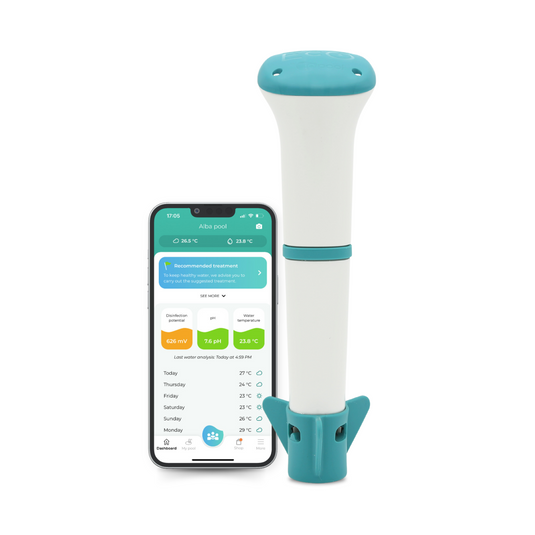
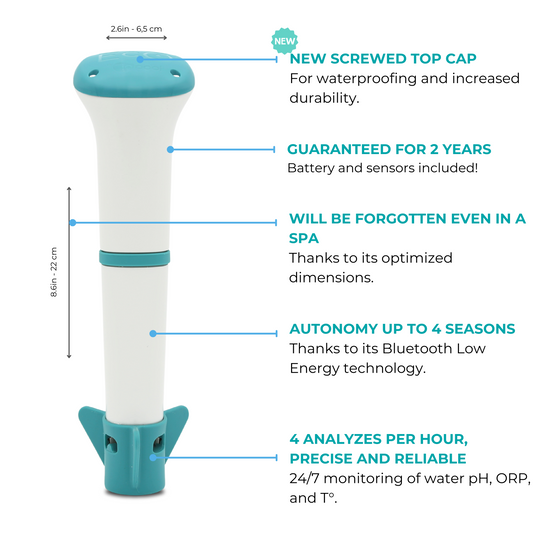
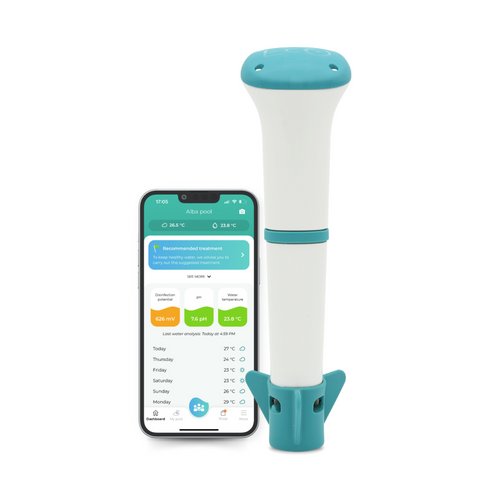
This is exactly where a connected analyzer like the iopool Eco Start Salt delivers real value. Designed specifically for salt-treated pools, it continuously measures pH, temperature, and ORP — sending you an alert the moment pH drifts, before sanitation effectiveness is compromised.
| Situation | Without a Connected Analyzer | With the iopool Eco Start Salt |
|---|---|---|
| pH gradually rising | Discovered on the weekly test: pH at 8.2, chlorine ineffective for several days | Alert sent when pH exceeds 7.5: immediate correction before loss of effectiveness |
| SCG set too high (overproduction) | Chlorine overdose goes undetected, water becomes irritating | High ORP flags the overdose: SCG output is adjusted |
| Heavy swim session in hot weather | ORP drop goes undetected, bacterial risk builds | ORP alert: SCG output adjusted or shock treatment applied |
| Vacation home / second property | No information between visits | Continuous remote monitoring, real-time alerts |
The iopool Eco Start Salt is compatible with all pools treated by salt electrolysis. It transforms insufficient weekly monitoring into continuous surveillance — particularly valuable for vacation homes or owners who don't want to check pH every day.
FAQ
Does a saltwater pool still contain chlorine?
Yes. The salt chlorine generator produces chlorine from the salt dissolved in the water. A saltwater pool is a chlorine pool with automated production. The difference is in how the sanitizer is generated, not in what it is.
Do saltwater pools irritate eyes less?
Generally yes. The SCG's continuous fresh chlorine production limits chloramine accumulation — the compounds responsible for eye irritation and the pool smell. The water feels softer. However, if pH isn't properly maintained, irritation can occur in a saltwater pool just as in a traditional one.
How much does a saltwater pool system cost?
The SCG unit alone runs $800 to $2,500. With an integrated pH controller: $1,500 to $4,000. Professional installation is recommended. In return, annual operating costs are low: $50 to $120 in salt, versus $200 to $500 in chemicals for a traditional chlorine pool. The investment typically pays off within 3 to 5 years.
Why does pH rise in a saltwater pool?
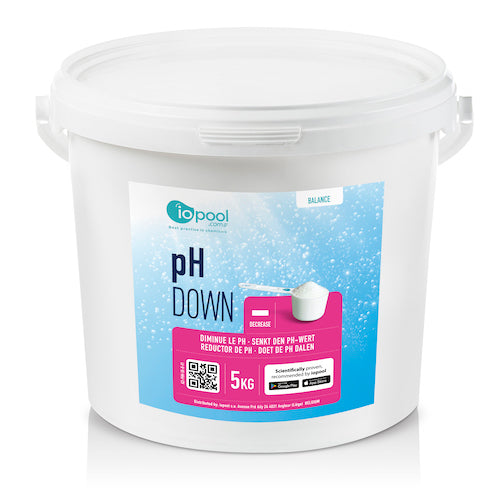
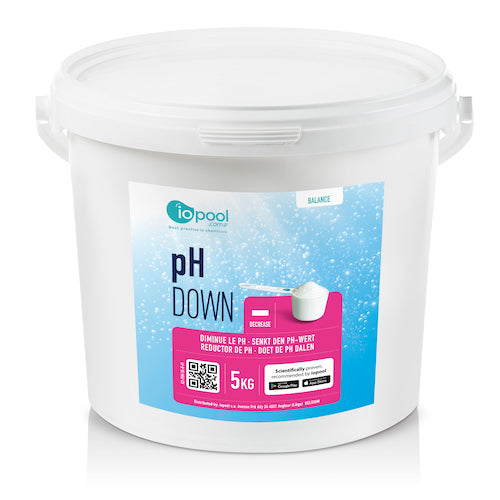
The electrolysis reaction that produces chlorine simultaneously releases sodium hydroxide (lye), a strongly alkaline byproduct. This continuous release drives pH upward constantly. It's inherent to the process, not a malfunction. The solution is to correct pH regularly with pH decreaser (dry acid or muriatic acid), or to install an automatic pH controller coupled to the SCG.
Should I shut down the SCG in winter?
Yes, once water temperature drops below 60°F. Below that threshold, water conductivity is insufficient: the SCG runs without producing adequate chlorine and prematurely wears its electrodes. Remove and store the cell frost-free. Switch to conventional chlorine for any transition periods when the pool remains filled.
How much salt does a pool need?
The target concentration is typically 2,700 to 3,500 ppm depending on the SCG manufacturer. For a 13,000-gallon pool, that's roughly 200 to 300 lbs of pool-grade salt on initial fill. Salt doesn't evaporate: top-ups are only needed after partial drains, heavy rain, or significant overflow.
Is a connected analyzer compatible with a saltwater pool?
Yes, provided you choose the right version. The iopool Eco Start Salt is specifically designed for electrolytic salt-treated pools. It monitors pH, ORP, and temperature continuously and alerts you the moment a parameter drifts — particularly valuable in saltwater pools where pH rises constantly and demands heightened vigilance.
Saltwater or traditional chlorine: which is the better option?
There's no universal answer. A saltwater pool is more comfortable and less demanding day-to-day when pH is properly managed — ideal with an automatic pH controller. Traditional chlorine is less expensive to install and simpler to manage for smaller budgets or above-ground pools. The choice depends on your installation budget, frequency of use, pool type, and tolerance for chemical monitoring.
Deciding between salt and chlorine for your pool project? Share your situation in the comments (pool volume, pool type, expected frequency of use) and our team will help you make the most suitable choice.