Limescale & Deposits: Understanding, Preventing, and Removing Them

White marks on pool walls, rough surfaces, cloudy water, or crust forming around waterlines — these are common signs of limescale buildup. While often seen as just a cosmetic issue, mineral deposits can affect water balance, equipment efficiency, and long-term durability.
Understanding what causes limescale is the first step toward preventing it.
What Is Limescale?
Limescale is primarily made of calcium carbonate, a mineral that forms when calcium hardness levels are high and water becomes oversaturated.
It typically appears:
- Along the waterline
- On pool tiles and liners
- Inside pipes and filtration systems
- On salt chlorinator cells
- On spa jets and heaters
Over time, these deposits harden and become more difficult to remove.
Why Does Limescale Form?
Limescale develops when water chemistry becomes unbalanced, particularly when:
- Calcium hardness is too high
- pH is above 7.6
- Total alkalinity is elevated
- Water temperature increases
- The Langelier Saturation Index (LSI) is positive
Warm water, such as in spas, accelerates scaling, which is why spas are particularly prone to mineral buildup.
Why Deposits Are a Problem
Beyond appearance, limescale can:
- Reduce heater efficiency
- Damage salt chlorinator cells
- Restrict water flow in pipes
- Shorten equipment lifespan
- Make surfaces rough and uncomfortable
Ignoring early signs can lead to expensive repairs.
How to Prevent Limescale
Prevention starts with proper water balance:
- Maintain calcium hardness within recommended levels
- Keep pH between 7.2 and 7.6
- Monitor total alkalinity
- Keep LSI close to neutral
- Avoid overdosing chemicals
- Clean salt cells regularly if using a salt system
Regular monitoring helps prevent scale before it becomes visible.
How to Remove Existing Deposits
If limescale has already formed:
- Use a descaling product suitable for pools or spas
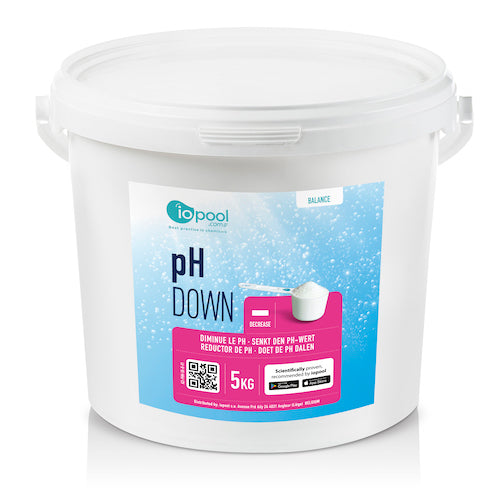
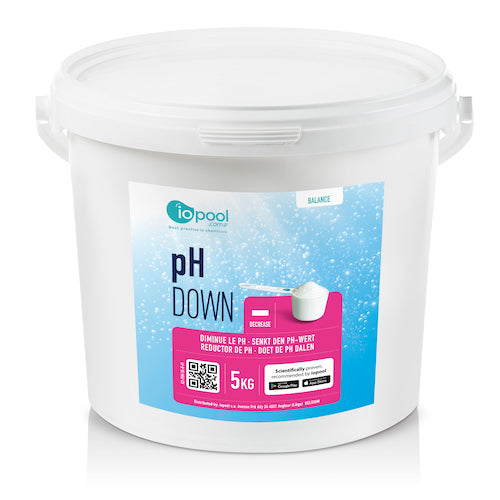
- Lower pH temporarily under professional guidance
- Clean affected surfaces with appropriate tools
- For severe cases, professional descaling may be required
Avoid aggressive scraping that can damage liners or coatings.
How EcO Helps Prevent Scaling
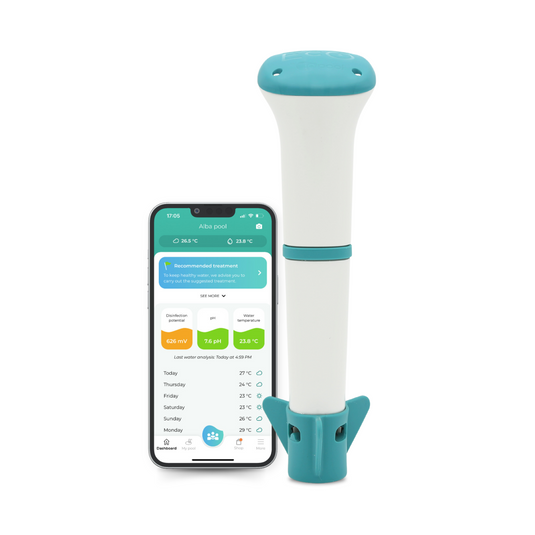
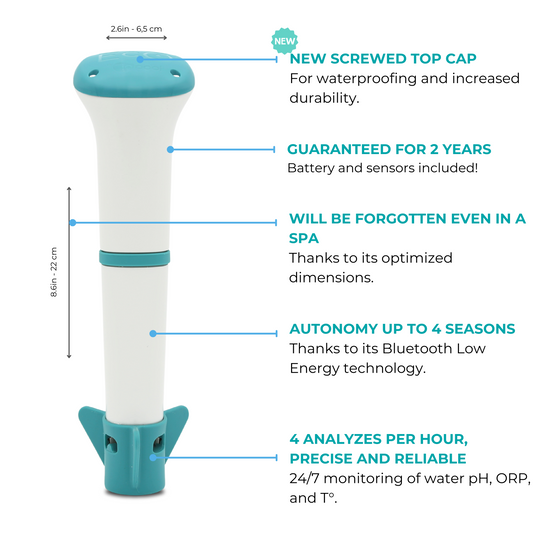
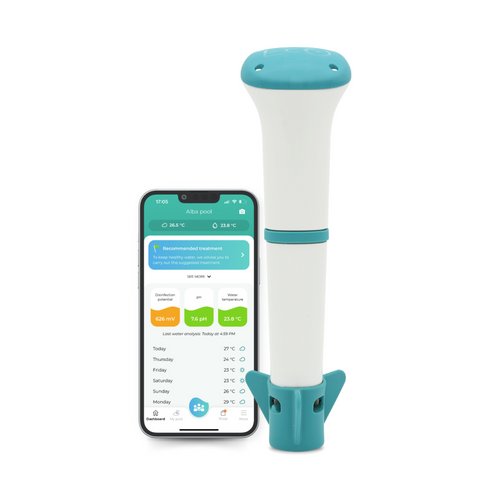
The EcO connected water analyzer continuously monitors pH, temperature, and sanitizer levels. Combined with the iopool app, it helps maintain balanced water and prevents the conditions that lead to a positive LSI and scaling.
By detecting imbalance early, you reduce the risk of mineral deposits forming in the first place.
Conclusion
Limescale and mineral deposits are not just cosmetic inconveniences — they are signs of water imbalance. By understanding calcium hardness, pH, and LSI, and maintaining consistent monitoring, you can protect both your water quality and your equipment.
Balanced water means smoother surfaces, clearer water, and longer-lasting installations.