El mejor analizador de agua de piscinas conectado: Cómo elegir el adecuado

Mejor analizador conectado de agua de piscina: cómo elegir el adecuado
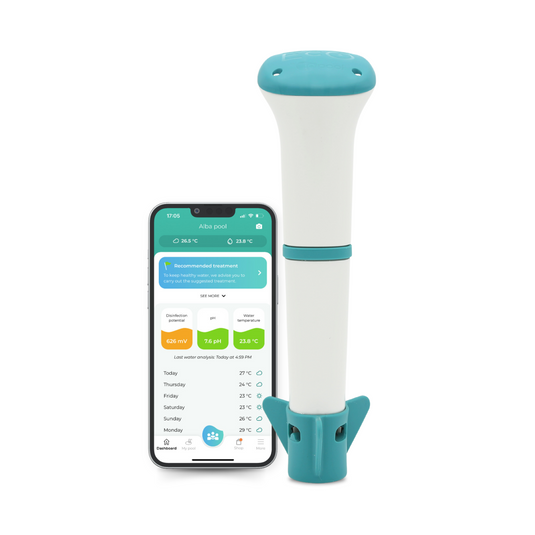
Respuesta breve: un analizador conectado de agua de piscina es un dispositivo flotante que monitoriza continuamente los parámetros clave de tu piscina —pH, ORP/potencial de desinfección y temperatura— y envía recomendaciones directamente a tu smartphone. Los principales criterios para elegir uno son el tipo de conectividad —Bluetooth o Wi-Fi—, si requiere suscripción, la vida útil de los sensores y el coste de sustitución, así como la compatibilidad con tu tipo de piscina —cloro, sal, piscina elevada—. Esta guía repasa cada criterio para ayudarte a tomar una decisión informada.
En este artículo:
- ¿Qué hace realmente un analizador conectado de piscina?
- Los 5 criterios que realmente importan
- Conectividad: Bluetooth vs. Wi-Fi
- ¿Con suscripción o sin suscripción?
- ¿Cuánto duran los sensores y cuánto cuesta reemplazarlos?
- ¿Con qué tipos de piscina es compatible?
- Qué miden los principales analizadores del mercado
- FAQ
¿Qué hace realmente un analizador conectado de piscina?
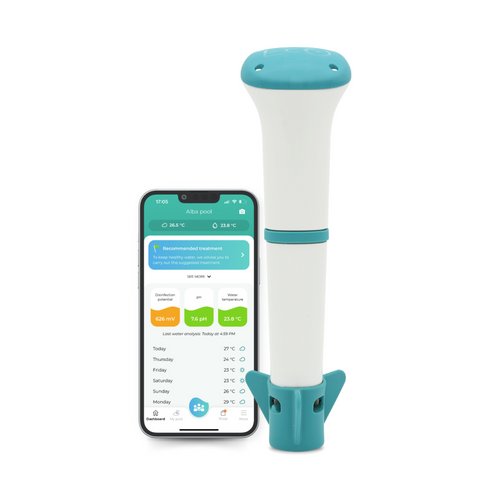
Un analizador conectado de agua de piscina es una sonda flotante que permanece en la piscina durante toda la temporada de baño. Mide continuamente dos o tres parámetros clave y envía esos datos a una aplicación móvil, que convierte las lecturas en recomendaciones claras: qué añadir, en qué cantidad y cuándo.
Lo que sustituye: las pruebas manuales con tiras reactivas o kits de gotas dos o tres veces por semana, las dosificaciones aproximadas y la reacción tardía cuando los problemas ya han aparecido.
Lo que no sustituye: las tareas físicas de mantenimiento de la piscina: retirar hojas, cepillar las paredes, hacer el contralavado del filtro o limpiar las cestas de los skimmers. Un analizador conectado se encarga del seguimiento químico; el trabajo manual sigue siendo tuyo.
¿Qué parámetros mide un analizador conectado?
| Parámetro | Qué indica | ¿Lo miden todos los analizadores? |
|---|---|---|
| pH | Acidez/alcalinidad del agua — condiciona la eficacia del cloro | Sí |
| ORP — potencial de oxidación-reducción | Poder real de desinfección del agua, independientemente de la dosis de cloro | Sí |
| Temperatura del agua | Influye en la degradación del cloro y en las necesidades de filtración | Sí |
| Conductividad / TDS | Contenido mineral, útil para piscinas de sal | Solo algunos modelos |
| Cloro libre — FC | Concentración de cloro activo | Raro: la mayoría de modelos usa el ORP como indicador indirecto |
Nota sobre ORP vs. cloro libre: la mayoría de analizadores conectados mide el ORP en lugar del cloro libre directamente. El ORP es, de hecho, un indicador más fiable de la eficacia de la desinfección: refleja lo que el cloro está haciendo, no solo cuánto cloro hay presente. Una piscina con un pH equilibrado y un ORP superior a 650 mV está bien desinfectada, independientemente del valor exacto de cloro. Este es el enfoque utilizado por iopool Eco Start, y es el mismo estándar de medición utilizado en piscinas comerciales y olímpicas.
Los 5 criterios que realmente importan
| Criterio | Por qué importa | Qué buscar |
|---|---|---|
| Tipo de conectividad | Determina si necesitas estar cerca de la piscina para obtener las lecturas | Wi-Fi para monitorización remota; Bluetooth solo requiere estar junto a la piscina |
| Suscripción | Coste recurrente que puede aumentar mucho en varios años | Prioriza modelos sin suscripción; calcula el coste total de propiedad |
| Vida útil de sensores y coste de sustitución | La mayoría de sensores se degradan tras 2 o 3 temporadas y deben reemplazarse | Comprueba el precio del módulo de sustitución antes de comprar |
| Compatibilidad con tu tipo de piscina | No todos los analizadores funcionan con piscinas de sal | Verifica explícitamente la compatibilidad con cloro, bromo o sal |
| Calidad de la app y claridad de las recomendaciones | El dispositivo solo es útil si la app te dice claramente qué hacer | Busca apps que den recomendaciones de dosificación, no solo números brutos |
Conectividad: Bluetooth vs. Wi-Fi
Este es el criterio más importante en la práctica. Determina si tu analizador funciona de forma pasiva en segundo plano o si debes acercarte a la piscina para obtener una lectura.
| Solo Bluetooth | Wi-Fi — o con gateway | |
|---|---|---|
| Cómo funciona | Abres la app cuando estás cerca de la piscina — unos 10 m de alcance | Los datos se sincronizan automáticamente a intervalos regulares y se pueden consultar desde cualquier lugar |
| Monitorización remota | No: requiere proximidad física | Sí: desde el trabajo, de vacaciones o desde cualquier lugar |
| Alertas automáticas | Solo cuando abres la app | Notificaciones push cuando los parámetros se desvían |
| Rango de precio | Precio de entrada más bajo | Más alto, o requiere comprar un gateway adicional |
| Ideal para | Propietarios que están en casa a diario y consultan la app con regularidad | Quien quiera una monitorización realmente pasiva o tenga una segunda residencia |
El iopool Eco Start utiliza Bluetooth por defecto y puede actualizarse a monitorización remota completa por Wi-Fi mediante el gateway opcional ioConnect —incluido en el pack Eco Start Connect—. Esto te da la flexibilidad de empezar con Bluetooth y actualizar más adelante si quieres acceso remoto.
¿Con suscripción o sin suscripción?
Algunos analizadores conectados del mercado bloquean funciones esenciales detrás de una suscripción de pago. Esto cambia significativamente el coste total de propiedad, y conviene calcularlo antes de comprar.
| Tipo de modelo | Coste de suscripción | Coste total en 3 temporadas — dispositivo + suscripción |
|---|---|---|
| Sin suscripción — por ejemplo, iopool Eco Start, Ondilo ICO | 0 $/año | Precio del dispositivo + módulo de sustitución de sensores |
| Modelos con suscripción | Normalmente 50–100 $/año | Precio del dispositivo + 150–300 $ en suscripciones durante 3 temporadas |
El iopool Eco Start no tiene suscripción. Todas las funciones de la app —monitorización continua, recomendaciones de dosificación, historial de parámetros y alertas— están incluidas sin coste adicional más allá de la compra del dispositivo.
¿Cuánto duran los sensores y cuánto cuesta reemplazarlos?
Este es el aspecto que más se pasa por alto al comparar analizadores conectados de piscina. Los sensores electroquímicos que miden pH y ORP se degradan con el tiempo por el contacto continuo con el agua de la piscina. Debes prever su sustitución tras 2 o 3 temporadas, independientemente de la marca.
| Aspecto | Qué comprobar |
|---|---|
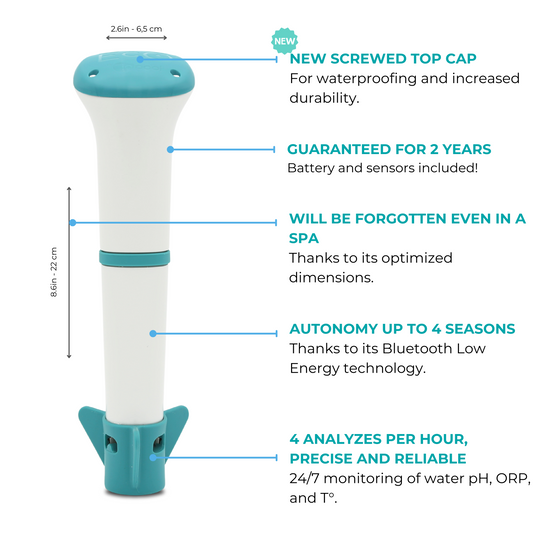
| Vida útil de los sensores | La mayoría de dispositivos: 2 a 3 temporadas. El iopool Eco Start está diseñado para durar hasta 4 temporadas — actualización 2024. |
| Coste del módulo de sustitución | Varía mucho según la marca. En iopool, un módulo de sensores de sustitución cuesta 99 $: no es necesario reemplazar todo el dispositivo. |
| Calibración anual | Algunos dispositivos requieren kits de calibración anuales — coste adicional. El iopool Eco Start solo requiere una calibración estacional con tiras incluidas: no hay que comprar un kit aparte. |
| Sustitución de batería | Algunos dispositivos tienen baterías reemplazables — coste adicional cada 2 años. El iopool Eco Start no tiene batería reemplazable: la unidad sellada se sustituye como módulo. |
¿Con qué tipos de piscina es compatible?
| Tipo de piscina | Notas de compatibilidad |
|---|---|
| Piscinas de cloro — enterradas o elevadas | Compatibles con todos los analizadores conectados del mercado |
| Piscinas de sal | Requieren una versión específica para sal. El iopool Eco Start Salt está diseñado para piscinas de sal. No todas las marcas ofrecen una versión compatible con sal. |
| Piscinas de bromo — spas, jacuzzis | Compatibles con la mayoría de analizadores; confirmar con el fabricante |
| Piscinas elevadas | Todos los analizadores flotantes son compatibles. El tamaño de la piscina no afecta a la compatibilidad, pero volúmenes muy pequeños — menos de 5.000 galones — pueden afectar a la precisión de las recomendaciones. |
| Segundas residencias / piscinas de vacaciones | Requieren un modelo conectado por Wi-Fi para que la monitorización remota sea útil |
Qué miden los principales analizadores del mercado
El mercado de analizadores conectados de piscina es principalmente europeo y está dominado por unas pocas marcas. Aquí tienes una comparación factual de lo que mide cada dispositivo y cómo se conecta.
| Dispositivo | Parámetros medidos | Conectividad | Suscripción | Vida útil de sensores |
|---|---|---|---|---|
| iopool Eco Start | pH, ORP, temperatura | Bluetooth — Wi-Fi mediante gateway opcional | Ninguna | Hasta 4 temporadas |
| Ondilo ICO | pH, ORP, temperatura, conductividad | Wi-Fi | Ninguna | Sensores individuales reemplazables |
| Flipr AnalysR | pH, ORP, temperatura | Bluetooth — Wi-Fi mediante gateway opcional | Ninguna — desde 2022 | 2 temporadas, kit de calibración anual requerido |
| Blue Connect Plus | pH, ORP, temperatura, conductividad | Bluetooth / Sigfox | Sí — 50 $/año para funciones completas | 2 a 3 temporadas |
| Intex | pH, ORP, temperatura | Wi-Fi | Ninguna | Debe recargarse cada dos semanas |
FAQ
¿Qué es un analizador conectado de agua de piscina?
Un analizador conectado de agua de piscina es un dispositivo flotante que monitoriza continuamente los parámetros clave del agua —normalmente pH, ORP y temperatura— y envía los datos a una aplicación móvil. La app convierte las lecturas en recomendaciones accionables: qué producto añadir, en qué cantidad y cuándo. Sustituye la necesidad de hacer pruebas manuales varias veces por semana.
¿Un analizador conectado sustituye las tiras reactivas?
Para el seguimiento diario del pH y del ORP/poder de desinfección, sí. Un analizador conectado ofrece lecturas más frecuentes y más constantes que las pruebas manuales. Sin embargo, no mide todos los parámetros: alcalinidad total, CYA —estabilizante— y fosfatos deben seguir analizándose manualmente una vez al mes, con tiras reactivas o fotómetro. Piensa en él como un sustituto de tus pruebas rutinarias semanales, no de tu análisis mensual completo.
¿Qué es el ORP y por qué los analizadores conectados lo usan en lugar del cloro libre?
El ORP —potencial de oxidación-reducción— mide el poder real de desinfección del agua: con qué eficacia puede destruir bacterias y algas. El cloro libre mide la cantidad de cloro presente, pero no si realmente está funcionando. Dos piscinas con el mismo valor de cloro libre pueden tener valores de ORP muy diferentes según el pH y los niveles de CYA. Un ORP superior a 650 mV indica que el agua está eficazmente desinfectada. Por eso las piscinas comerciales y olímpicas usan el ORP como métrica principal de desinfección, y por eso es lo que mide el iopool Eco Start.
¿Vale la pena comprar un analizador conectado de piscina?
Depende de cómo gestiones actualmente tu piscina. Para propietarios que ya hacen pruebas con frecuencia y se sienten cómodos con la química del agua, el beneficio principal es la comodidad y las alertas tempranas. Para quienes tienen dificultades para mantener una rutina de análisis o han sufrido problemas recurrentes —agua verde, irritaciones, agua turbia—, un analizador conectado suele amortizarse en una o dos temporadas gracias al ahorro en tratamientos químicos y tiempo.
¿Necesito Wi-Fi para que funcione un analizador conectado de piscina?
No necesariamente. Los modelos solo Bluetooth, como el iopool Eco Start básico, funcionan sin Wi-Fi: simplemente abres la app cuando estás cerca de la piscina para sincronizar las últimas lecturas. El Wi-Fi —o un gateway— solo es necesario si quieres acceso remoto desde cualquier lugar o notificaciones automáticas sin estar junto a la piscina. Para una segunda residencia o una propiedad vacacional, la conectividad Wi-Fi se vuelve mucho más valiosa.
¿Con qué frecuencia mide un analizador conectado?
Depende del dispositivo. El iopool Eco Start realiza una medición cada 15 minutos, uno de los intervalos de medición más frecuentes del mercado. Una mayor frecuencia permite detectar más rápido cambios repentinos, como subidas de pH tras añadir productos químicos o después de lluvias intensas.
¿Puede funcionar un analizador conectado con una piscina de sal?
Sí, pero debes verificar la compatibilidad. El iopool Eco Start estándar está diseñado para piscinas de cloro y bromo. El iopool Eco Start Salt es la versión dedicada a piscinas de sal. No todas las marcas ofrecen una versión compatible con sal: confírmalo siempre antes de comprar.
¿Qué pasa cuando los sensores se desgastan?
Los sensores electroquímicos se degradan con el tiempo debido al contacto continuo con el agua de la piscina. La mayoría de los analizadores conectados necesitan sustituir sus sensores después de 2 o 3 temporadas. Con el iopool Eco Start V2, el mantenimiento es ahora más sencillo y económico: puedes sustituir tú mismo los sensores y la batería, por separado, utilizando kits de recambio específicos.
Si es necesario sustituir ambas piezas, iopool también ofrece un pack combinado que incluye el kit de sensores y el kit de batería en un solo lote. Esto significa que ya no necesitas reemplazar el dispositivo completo, sino únicamente los componentes desgastados. La pasarela Wi-Fi Connect, si tienes una, no necesita ser reemplazada.
¿Todavía no sabes qué analizador conectado es el adecuado para tu piscina? Deja un comentario con tu tipo de piscina, volumen y cómo analizas actualmente el agua: nuestro equipo te ayudará a encontrar la mejor opción.
Compre los esenciales