Limescale, Hardness, and White Deposits: Understand Before You Treat

You've noticed a white, chalky ring around the waterline. Or a rough, gritty texture on the pool walls. Maybe your water looks cloudy even though the chlorine is fine. These are all classic signs of limescale — and if you've ever tried to treat it without understanding where it comes from, you've probably noticed that it comes back.
That's because limescale isn't a random occurrence. It's the direct consequence of your water chemistry, and more specifically of something called calcium hardness. Treat the symptom without addressing the cause, and you're just buying time.
In Brief
Limescale in pools forms when water contains too much dissolved calcium and becomes supersaturated — the excess calcium precipitates out and deposits on surfaces, equipment, and pipework. This is driven by water hardness (TH), pH, and temperature. White deposits are almost always a calcium problem, not a chlorine or algae problem. The solution is to understand your water balance first, then act on the right parameter — usually by reducing calcium hardness, lowering pH, or partially draining and refilling the pool.
What Is Water Hardness, Exactly?
Water hardness refers to the concentration of dissolved minerals in the water — primarily calcium and magnesium ions. It's measured in French degrees (°f) or ppm (parts per million), depending on where you are.
Hard water isn't inherently dangerous for swimming. But in a pool, where water is continuously heated, evaporated, and chemically treated, hardness levels tend to rise over time. Every time water evaporates, the minerals stay behind — the water level drops, but the calcium doesn't go anywhere. You top up with fresh water, which brings more minerals in. Over a season, calcium hardness can increase significantly even if your source water isn't particularly hard.
The ideal calcium hardness range for a pool is generally 150–300 ppm (or roughly 15–30 °f). Below 150 ppm, water becomes aggressive — it will try to dissolve calcium from wherever it can find it, including your pool walls, grout, and equipment. Above 300 ppm, the water becomes saturated and starts depositing calcium on every surface it touches.
Why Does Limescale Form?
Calcium doesn't deposit randomly. It precipitates when water becomes supersaturated — when it's holding more dissolved calcium than it can keep in solution. Several factors push water toward this tipping point:
High calcium hardness is the obvious one. The more calcium dissolved in the water, the closer you are to saturation.
High pH is the hidden accelerator. Calcium is much more soluble in slightly acidic water than in alkaline water. As pH rises above 7.6–7.8, calcium starts precipitating out of solution much more readily. This is why limescale problems often get worse in summer — heat causes pH to rise naturally, which triggers deposition even if hardness hasn't changed.
High temperature reduces the solubility of calcium carbonate directly. Heated pools and spa pools are particularly prone to limescale for this reason.
High total alkalinity contributes indirectly. Alkalinity acts as a pH buffer, and when it's too high, it pushes pH upward — which, as we've just seen, accelerates precipitation.
These factors interact through something called the Langelier Saturation Index (LSI), a formula that pools all these parameters into a single number to predict whether water will tend to deposit scale (positive LSI) or corrode surfaces (negative LSI). You don't need to calculate it manually — but understanding the concept helps you see why treating hardness in isolation isn't always enough.
Recognizing Limescale in Your Pool
White or grey deposits around the waterline are the most visible sign — this is where evaporation is most intense, so calcium concentrates and deposits there first. The texture is typically rough, chalky, or crusty.
Rough patches on the pool floor or walls, a gritty feel underfoot, or a progressively narrowing pipe diameter in your filtration system are signs of more advanced scaling. In severe cases, limescale can reduce flow through your filter and heater, increasing energy consumption and causing premature wear.
Cloudy water with correct chlorine levels can also be a limescale symptom — when calcium precipitates as fine particles suspended in the water rather than depositing on surfaces, it gives the water a milky, hazy appearance that clarifiers and filtration alone won't fully resolve.
It's worth noting that not all white deposits are limescale. White flaking or peeling in certain pool types can also indicate paint or plaster deterioration. The difference: limescale is hard and rough to the touch; paint or plaster flakes tend to be softer and come off in sheets or chips.
How to Treat Limescale
Step one: test your water properly
Before doing anything, measure your calcium hardness, pH, and total alkalinity. Acting without these numbers is guesswork. You need to know which parameter is out of range — or whether it's the combination that's the problem.
Bring pH down if it's elevated
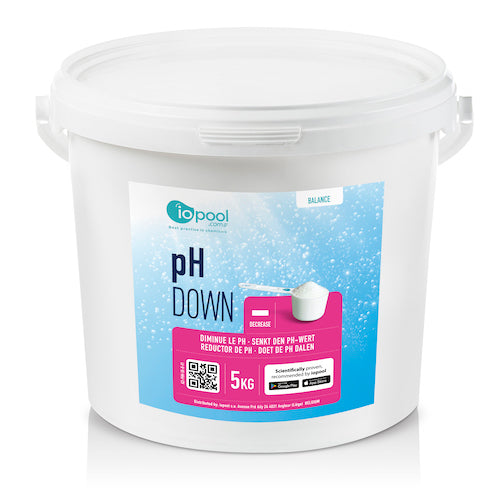
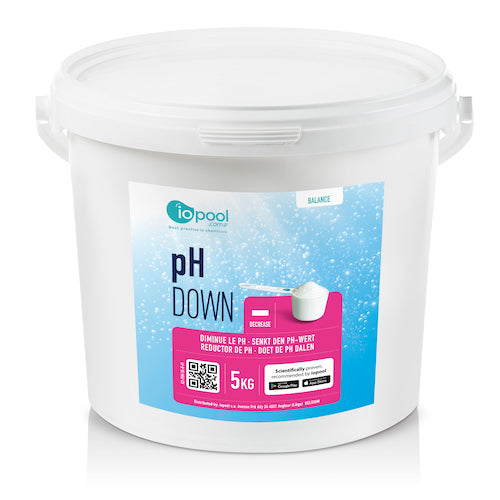
If your pH is above 7.8, correcting it is the first move. Lowering pH increases calcium solubility, which slows or stops new deposition. Use a pH reducer (pH minus) and bring your pH back into the 7.2–7.4 range. This won't dissolve existing deposits, but it will stop the situation from getting worse.
Address calcium hardness directly
If hardness is above 300 ppm and pH correction alone isn't enough, you have two main options:
Partial drain and refill. Draining 20–30% of the pool and replacing it with fresh water is the most effective way to dilute calcium hardness. It's straightforward but requires time and water. If your tap water is itself very hard, it helps less than expected — in that case, using softened water or a mix is worth considering.
Anti-scale products. Sequestering agents and anti-scale treatments don't remove calcium — they bind to it and keep it in solution, preventing it from precipitating. They're a useful maintenance tool, especially in hard water areas, but they're not a cure. Think of them as a way to manage the problem rather than eliminate it.
Remove existing deposits
For surface deposits on walls and the waterline, a descaling product applied by hand (or with a brush) is usually the most practical approach. Acidic cleaners dissolve calcium carbonate effectively — but use them carefully, follow the instructions, and rinse thoroughly. For equipment internals (heater, pump, pipework), a specialist descaling treatment or professional flush may be needed.
Preventing Limescale from Coming Back
The real fix is maintaining water balance consistently throughout the season:
- Keep pH in the 7.2–7.4 range — this is your first line of defense
- Monitor calcium hardness regularly and dilute before it approaches 300 ppm
- Keep total alkalinity in the 80–120 ppm range to avoid pH drift
- Use an anti-scale product as a routine preventive measure if you're in a hard water area
- Cover your pool when not in use to limit evaporation-driven concentration
Monitoring these parameters together — not in isolation — is what makes the difference between managing a symptom and actually preventing the problem.
FAQ
My water is hard but I don't see any deposits. Should I still treat it? Yes, preventively. Deposits form once water reaches saturation — by the time you see them, hardness has already been elevated for a while. Keeping hardness below 300 ppm and pH in range will stop deposits from forming in the first place.
Can I use a water softener to fill my pool? Softened water replaces calcium with sodium ions, which avoids scaling but can affect water balance and TDS (total dissolved solids). It's an option in very hard water areas, but use it to dilute rather than replace — a mix of softened and untreated water is usually more appropriate than 100% softened water.
Is limescale harmful to swimmers? Not directly. But rough, scaly surfaces can be uncomfortable and can harbor bacteria more easily than smooth ones. More importantly, the same conditions that cause limescale — high pH, elevated hardness — reduce chlorine effectiveness, which is a real hygiene concern.
Can limescale damage my pool equipment? Yes, over time. Scale buildup inside a heater or pump reduces efficiency and can cause premature failure. Regular descaling and water balance maintenance protect your equipment as much as your pool surfaces.
Why does my waterline get deposits even when my water chemistry seems fine? Waterline deposits form at the evaporation zone, where mineral concentration is highest. Even with balanced water, a small amount of deposition is possible over time at this specific spot. Regular cleaning of the waterline and consistent anti-scale treatment minimize this.
Compre los esenciales