Above-Ground Pool Water Maintenance: What's Different and How to Get It Right

Short answer: Above-ground pool maintenance uses the same parameters as in-ground pools (pH, chlorine, TA, stabilizer), but with three specific constraints: a smaller water volume that makes imbalances faster and more severe, often weaker filtration, and sun-exposed walls that raise water temperature more quickly. These constraints mean more frequent testing and faster responses. This guide covers everything you need to keep an above-ground pool's water healthy, with adjustments for these specific challenges.
What's Different About an Above-Ground Pool
The chemistry of water maintenance is identical for all pool types. What changes with above-ground pools is the speed at which problems appear and escalate.
| Specific Constraint | What It Means in Practice | Required Adjustment |
|---|---|---|
| Smaller water volume (1,300 to 8,000 gallons typically) | A pH or chlorine imbalance spreads through the entire pool within hours. A poorly dosed product has an immediate, strong impact. | Smaller doses, more frequent corrections, wait before retesting |
| Often limited filtration (low-flow pump) | The filter may not be powerful enough to keep water clear during heavy use or intense heat | Increase filter run time, clean the cartridge more often |
| Sun-exposed walls | Water temperature rises faster than in in-ground pools, accelerating chlorine degradation and algae growth | Check chlorine more frequently in hot weather, use a pool cover |
| No main drain in most models | Floor debris isn't automatically removed — it accumulates and consumes chlorine | Manually vacuum the floor regularly |
| High surface-to-volume ratio | More surface area per gallon in contact with air, UV, and external contaminants | Cover the pool when not in use |
In a 2,600-gallon above-ground pool, a single swim session with four people can cut free chlorine in half. In a 16,000-gallon in-ground pool, the same event barely registers. That's the core challenge of above-ground pools: every disruption has a proportionally larger impact.
Parameters to Monitor and Target Values
Target values are identical to those for in-ground pools. What changes is the recommended testing frequency.
| Parameter | Ideal Range | Frequency (in-ground) | Recommended Frequency (above-ground) |
|---|---|---|---|
| pH | 7.2 – 7.4 | 2 to 3 times/week | Every 1 to 2 days during peak season |
| Free Chlorine | 1 – 3 ppm | 2 to 3 times/week | Every 1 to 2 days during peak season |
| Total Alkalinity (TA) | 80 – 120 ppm | Once a month | Once a month (same) |
| CYA (Stabilizer) | 30 – 50 ppm | Start and mid-season | Start and mid-season (same) |
| Phosphates | Below 100 ppb | Once a month | Once a month (same) |
| Water Temperature | Ideally below 82°F | Informational | Watch closely: above 82°F, double your vigilance |
Filtration: Adapted Rules for Above-Ground Pools
Filtration is the weak point of most above-ground pools. The pumps included in kit pools are often undersized for periods of intense heat or heavy use.
Recommended Filter Run Time
| Water Temperature | Minimum Daily Filter Run Time | Above-Ground Specific Note |
|---|---|---|
| Below 68°F | 4 to 6 hours/day | Can be reduced if the pool is lightly used |
| 68 – 77°F | 8 hours/day minimum | Split into 2 cycles (morning and evening) |
| 77 – 82°F | 10 to 12 hours/day | Note: above-ground walls heat up faster, raising water temp |
| Above 82°F | 14 to 24 hours/day | Consider continuous filtration during heat waves |
Filter Type: Cartridge or Sand?
| Cartridge Filter | Sand Filter | |
|---|---|---|
| Found on | Most small above-ground pools (Intex, Bestway, models under 5,000 gallons) | Mid to large above-ground pools (5,000 gallons and above) |
| Maintenance | Rinse with clean water 1 to 2 times/week, replace every 2 to 4 weeks | Backwash every 2 to 4 weeks, replace sand every 5 years |
| Filtration quality | Less fine, doesn't capture the smallest particles | Finer filtration, better water clarity |
| Key warning | Never use liquid flocculant with a cartridge filter — it clogs instantly | Check pressure gauge before each backwash |
Chemical Treatment: Frequencies and Dosing
Chlorine in Above-Ground Pools: Specific Considerations
Chlorine degrades much faster in above-ground pools for two reasons: the shallow depth exposes the entire water column to UV, and the temperature rises more quickly. Unstabilized chlorine can disappear within hours on a hot, sunny day.
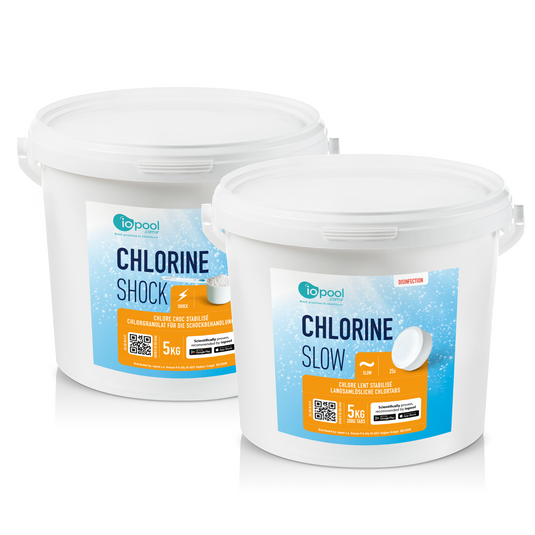
- Recommended form: slow-release trichlor tablets (3-inch) in a floating dispenser for routine maintenance. Never place a tablet directly on the liner — it will leave a permanent white bleach stain.
- Frequency: check chlorine every 1 to 2 days during peak season. Adjust dosing to actual bather load.
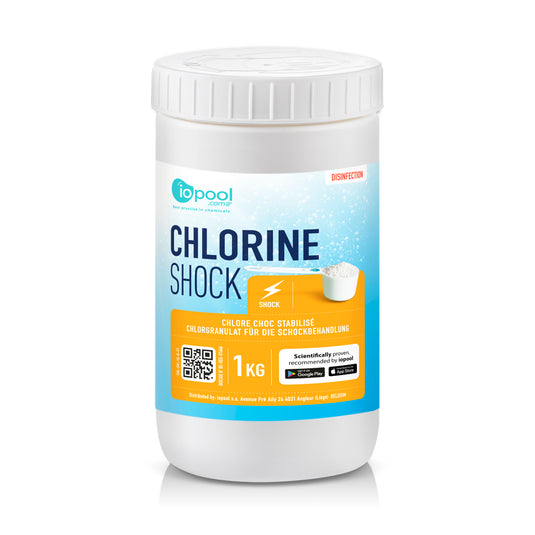
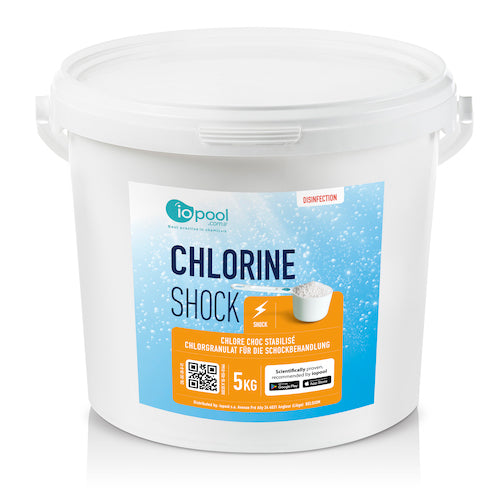
- Shock treatment: after every heavy swim session, after a storm, or if chlorine drops to zero. Use unstabilized chlorine (calcium hypochlorite granules or liquid chlorine).
- Stabilizer (CYA): keep between 30 and 50 ppm to protect chlorine from UV. Monitor it closely — small volumes accumulate CYA faster than large pools.
Correction Order to Follow
Total Alkalinity → pH → Phosphates → Chlorine. Correcting out of sequence makes every treatment less effective. In above-ground pools, wait 4 to 6 hours between each correction before retesting — small volumes react faster but still need time to homogenize.
Dosing: Watch Out for Small Volumes
| Pool Volume | Dry Acid Dose to Drop pH by 0.2 Points | Shock Dose (curative treatment) |
|---|---|---|
| 1,300 gallons (5 m³) | 1 – 1.1 oz (28 – 30 g) | 5 – 7 oz (150 – 200 g) of 65% cal-hypo |
| 2,600 gallons (10 m³) | 1.8 – 2 oz (50 – 60 g) | 10 – 14 oz (300 – 400 g) |
| 5,300 gallons (20 m³) | 3.5 – 4 oz (100 – 120 g) | 21 – 28 oz (600 – 800 g) |
| 8,000 gallons (30 m³) | 5 – 6 oz (150 – 180 g) | 32 oz – 2.6 lbs (900 g – 1.2 kg) |
Golden rule for above-ground pools: always pre-dilute chemicals in a bucket of water before adding to the pool. In a small volume, undiluted product can create a locally very high concentration that bleaches the liner or violently destabilizes parameters.
Weekly Maintenance Schedule
| Frequency | Task | Estimated Time |
|---|---|---|
| Daily | Skim the surface, visual check of the water | 5 min |
| Every 1 to 2 days | Test pH and free chlorine, adjust if needed | 10 min |
| 1 to 2 times per week | Brush walls and floor, vacuum debris | 15 to 20 min |
| Once a week | Clean the filter cartridge (or check pressure if sand filter) | 10 min |
| Once a week | Clean the waterline | 5 min |
| After every heavy swim session | Test chlorine and pH, preventive shock if needed | 10 min |
| Once a month | Full water analysis (TA, stabilizer, phosphates) | 15 min |
Estimated weekly total: 45 to 60 minutes without automation. With a connected analyzer handling chemical monitoring, that drops to 20 to 30 minutes.
Why a Connected Analyzer Matters Even More for Above-Ground Pools
Connected pool analyzers are often associated with large in-ground pools. That's a misconception — continuous monitoring actually delivers its greatest value in small water volumes, where problems develop fastest.
In a 16,000-gallon in-ground pool, a missed treatment or a heavy swim session creates an imbalance that takes two to three days to become visible. You have time to catch it manually. In a 2,600-gallon above-ground pool, the same event can turn the water green in 12 to 24 hours. The window for intervention is much shorter — and manual testing every two days simply isn't frequent enough to reliably catch it in time.
What Changes With a Connected Analyzer in an Above-Ground Pool
| Situation | Without a Connected Analyzer | With the iopool Eco Start |
|---|---|---|
| After a swim session with several people | You test the next morning: chlorine is already at zero, water is starting to green | An alert arrives on your phone a few hours after swimming: you add chlorine the same evening |
| During a heat wave | Chlorine degrades within hours: without daily testing, you find out too late | ORP drops below the threshold and you're alerted immediately, before algae can take hold |
| After a storm | You don't necessarily think to test within 24 hours: pH has drifted and chlorine is diluted | pH shifts out of range within hours: you get a push notification and correct before the next swim |
| While you're away (at work, out for the evening) | No information about water quality during your absence | You check your pool's status from your smartphone anytime, from anywhere |
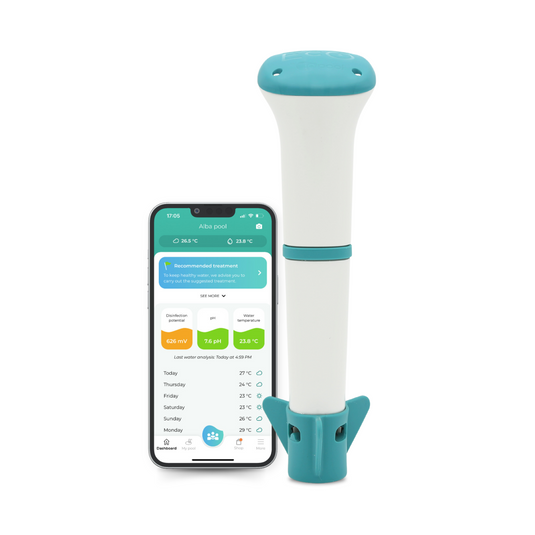
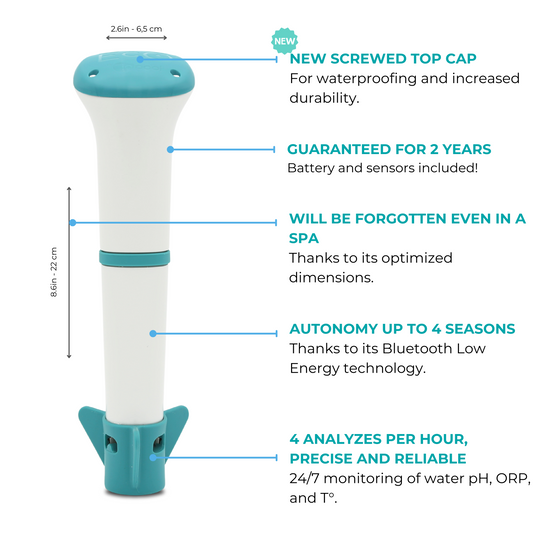
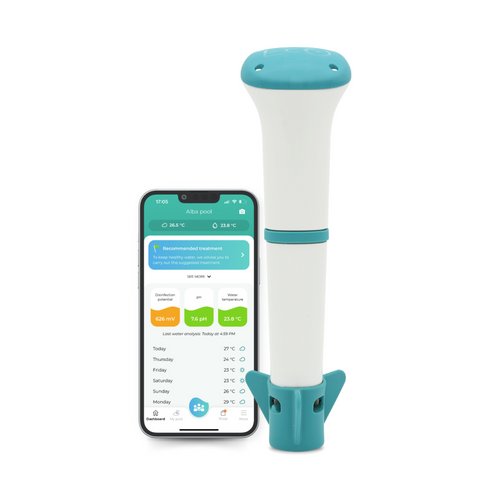
The iopool Eco Start measures pH, temperature, and ORP every 15 minutes and sends you a clear recommendation the moment a parameter drifts: what to add, how much, and when. It's compatible with all above-ground chlorine pools from 5,000 gallons (20 m³). For above-ground saltwater pools, the iopool Eco Start Salt version is available.
The practical result: you move from manual testing every one to two days to continuous monitoring — and you never again discover a green pool after a night of heat or a weekend away.
When to Change the Water in an Above-Ground Pool
This is a question specific to above-ground pools that in-ground pool owners never have to ask. The answer depends on pool type and volume.
| Pool Type | Recommended Replacement Frequency | Signs a Change Is Needed |
|---|---|---|
| Small inflatable or frame pool (under 1,300 gallons) | Every 1 to 2 weeks during peak season | Water impossible to clear, CYA too high |
| Mid-size above-ground pool (1,300 to 4,000 gallons) | 1 to 2 times per season, or when recurring problems occur | CYA above 75 ppm, recurring green water |
| Large above-ground pool (4,000 to 8,000 gallons) | Every 2 to 3 years (same as in-ground) | CYA accumulation, water impossible to balance |
Worth knowing: for very small pools without a filtration system, a complete drain and refill is often more effective and cheaper than intensive chemical treatment. There's no point fighting with products to save 500 gallons of degraded water.
Most Common Problems and Solutions
| Problem | Above-Ground Specific Cause | Adapted Solution |
|---|---|---|
| Water turns green within 24 to 48 hours | Chlorine consumed very rapidly by heat and UV (shallow depth) | Check stabilizer level, increase testing frequency, cover when not in use |
| pH impossible to stabilize | Small volume and unstable TA: pH reacts strongly to every chemical addition | Bring TA to 80–120 ppm first, then correct pH in very small increments |
| Cloudy water after every swim session | Rapid organic overload in a small volume, chlorine consumed immediately | Preventive shock after every heavy swim, ask swimmers to shower first |
| White stain on liner | Trichlor tablet placed directly on the floor | Always use a floating tablet dispenser, never place tablets on the liner |
| Foam on the surface | Organic matter (lotions, cosmetics) or algaecide overdose | Pool-specific defoamer, then shock treatment to eliminate organic matter |
| Chlorine disappears within hours | Insufficient or absent stabilizer, intense sun exposure | Check and adjust CYA to 30–50 ppm |
FAQ
Is maintaining an above-ground pool harder than an in-ground pool?
The principles are identical, but monitoring needs to be more frequent. An imbalance that would take several days to become visible in a 16,000-gallon in-ground pool can cloud a 2,600-gallon above-ground pool within 24 hours. The vigilance required is higher, but corrections are also faster to achieve.
How long should I run the filter on an above-ground pool each day?
The baseline rule is: water temperature in °F divided by 2, expressed in hours. At 80°F, that's 40 hours — so run continuously or close to it. At 75°F, around 37 hours per week. For small pools with cartridge filters, a minimum of 8 hours per day is needed during peak season, split across two cycles. Above 82°F, run the filter continuously.
Can I leave an above-ground pool without maintenance while on vacation?
No. A week without maintenance in midsummer is enough to turn clear water green, especially in a small volume. Options: ask a neighbor to add chlorine and check pH every two days, add a preventive algaecide before you leave, keep the filter running on a timer, and cover the pool to limit debris and reduce chlorine evaporation.
What products should I use for an above-ground pool?
The same as for an in-ground pool: pH increaser, pH decreaser, stabilized chlorine (trichlor tablets) for routine maintenance, unstabilized chlorine (cal-hypo granules or liquid chlorine) for shock treatments, preventive algaecide, and a clarifier when needed. Choose smaller packaging sizes suited to your volume to avoid accidental overdosing.
Is a connected pool analyzer useful for a small above-ground pool?
Especially useful, precisely because of the above-ground pool's specific challenges. A small volume goes out of balance quickly — often between two manual tests. The iopool Eco Start monitors pH and ORP continuously and alerts you the moment a parameter drifts. That's even more valuable when every hour of imbalance has a strong impact on the water. It's also a practical solution for first-time pool owners who are still learning the chemistry.
How do I keep an above-ground pool from overheating?
Use a pool cover when not swimming (it also slows chlorine evaporation and keeps debris out). Position the pool in partial shade if possible. Above 82°F, double your chlorine vigilance (it degrades faster) and increase filter run time. Avoiding swimming during the hottest hours of the day also limits organic matter buildup at high temperatures.
Should I drain and store my above-ground pool for winter?
For inflatable and small frame pools: yes, disassembly and frost-free storage is recommended. The plastic doesn't handle freeze-thaw cycles well. For larger steel, wood, or composite above-ground pools: passive winterization (winter cover, winterizing chemicals, equipment protection) is possible depending on your climate. Never leave water in the plumbing or pump where it could freeze.
New to above-ground pool ownership and have questions about the right products or doses for your volume? Share your pool volume and filter type in the comments and our team will put together a personalized maintenance schedule for you.