Pool Stabilizer: What It Does, What Level to Aim For, and What to Do If It's Too High

In Brief
Pool stabilizer — also known as cyanuric acid or CYA — protects chlorine from being destroyed by UV rays. Without it, up to 90% of your chlorine can disappear within a few hours on a sunny day. The ideal range is 30–50 ppm. Below that, chlorine burns off too fast. Above 100 ppm, chlorine becomes ineffective even when present — a condition known as over-stabilization or chlorine lock. The only fix is dilution.
What Is Pool Stabilizer?
Pool stabilizer — whose chemical name is cyanuric acid, often abbreviated CYA — is an organic molecule that binds to chlorine in water and shields it from UV degradation. It has no disinfecting power on its own. Its sole job is to keep chlorine active longer.
Without stabilizer, free chlorine in a sun-exposed pool can nearly vanish in under two hours on a hot day. That's not a quality issue with the product — it's just physics. UV rays break down chlorine at a remarkable speed.
How the protection works: the stabilizer forms a temporary, reversible bond with active chlorine molecules. This bond blocks UV rays from reaching the chlorine. The chlorine is then gradually released back into the water to continue disinfecting. The bond doesn't neutralize the chlorine — it just slows its degradation.
What Stabilizer Level Should You Aim For?
| Level | Status |
| Below 30 ppm | Insufficient — chlorine degrades too quickly |
| 30–50 ppm | Ideal — optimal protection without inhibiting chlorine |
| 50–70 ppm | Acceptable in some conditions |
| Above 100 ppm | Over-stabilization — action required |
Note on the unit: ppm stands for parts per million. 30 ppm means 30 mg of stabilizer per liter of water. Most test strips and pool analyzers measure directly in ppm.
How Stabilizer Gets Into Your Pool
There are two main sources.
Pure stabilizer (granules or liquid): added directly at the start of the season, usually once. Stabilizer is chemically stable — unlike chlorine, it doesn't break down in water. It only decreases through dilution: heavy rain, partial draining, or water overflow.
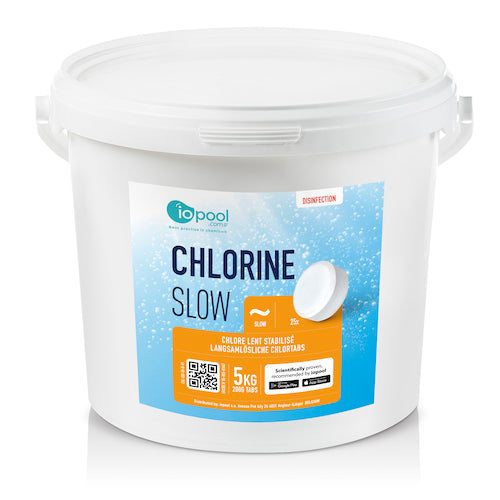
Stabilized chlorine tablets: the most common and often overlooked source. Slow-release chlorine tablets already contain stabilizer (cyanuric acid). Every tablet you add brings both chlorine and stabilizer into the pool. Over the course of a season — and from one season to the next without partial draining — stabilizer levels accumulate silently.
If you use stabilized chlorine tablets exclusively, you rarely need to add pure stabilizer on top. But long-term buildup needs monitoring.
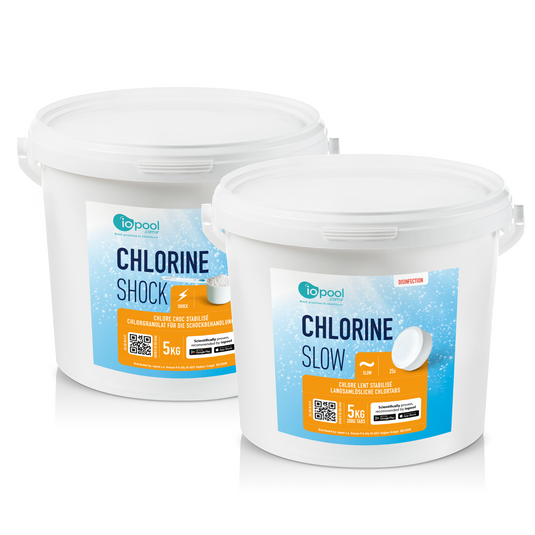
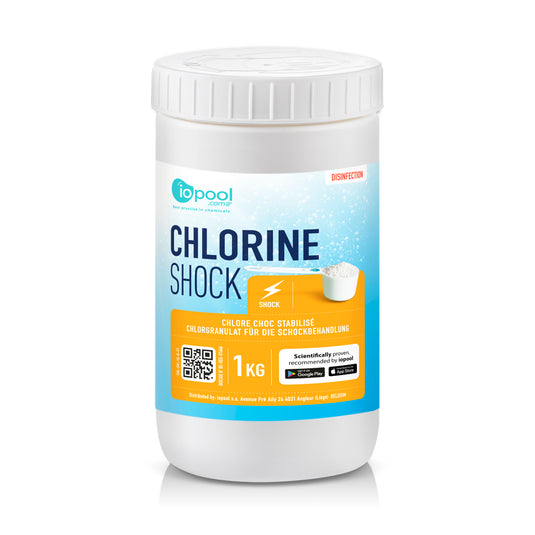
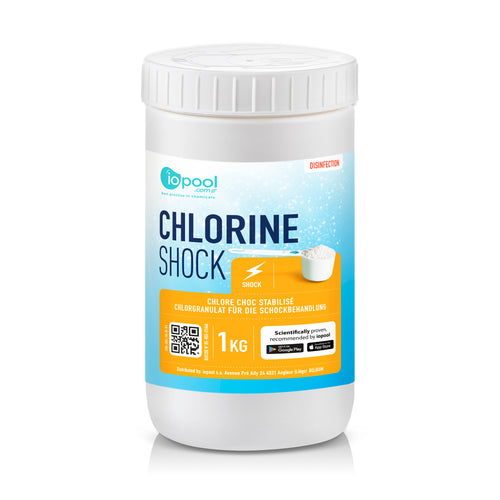
Chlorine shock is generally unstabilized — it doesn't add extra stabilizer. It's a useful complement when you need to disinfect without pushing your stabilizer level higher.
Stabilizer Too High: What Should You Do?
1. Diagnosis: Your stabilizer level exceeds 100 ppm. That's the threshold above which things become problematic — even if everything looks fine to the naked eye.
2. Likely causes
- Exclusive use of stabilized chlorine tablets over multiple seasons without partial draining
- Adding pure stabilizer on top of tablets — unnecessary and cumulative
- No water renewal at the end or start of the season
3. Concrete consequences
- Chlorine is present in the water but no longer disinfects effectively
- Algae can appear despite an apparently correct chlorine reading
- Chlorine shock has little or no visible effect
4. Solution: Renew between 20 and 40% of the pool volume depending on the measured level. Partially drain, then refill with fresh water. Retest before resuming normal treatments. There is no reliable chemical product to remove stabilizer — dilution is the only option.
Does Too Much Stabilizer Really Block Chlorine?
Yes — and this is where many pool owners get caught off guard. When stabilizer concentration exceeds 100 ppm, the bond between stabilizer and chlorine becomes too stable. Chlorine is no longer released efficiently enough to eliminate bacteria and algae.
The result is counterintuitive: your tester shows chlorine is present, the water looks fine — but it's not actually being disinfected. This is sometimes called chlorine lock.
Warning signs:
- Algae appearing despite a normal chlorine reading
- Persistent cloudy water that doesn't respond to treatment
- Chlorine shock with no visible effect
How to Measure Your Stabilizer Level
- Multi-parameter test strips: quick and practical, reliable enough for regular monitoring
- Liquid test kits: more precise, colorimetric reading
- Connected analyzers: some smart sensors provide continuous monitoring and alert you when a parameter drifts out of range
When to test: at pool opening, mid-season, and after any significant water addition (heavy rain, refilling after a partial drain).
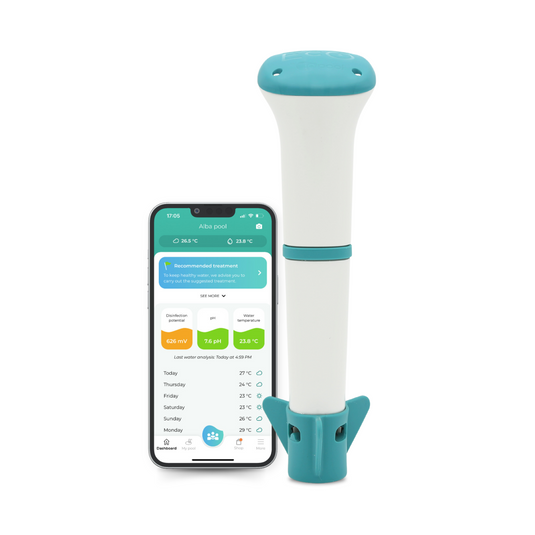
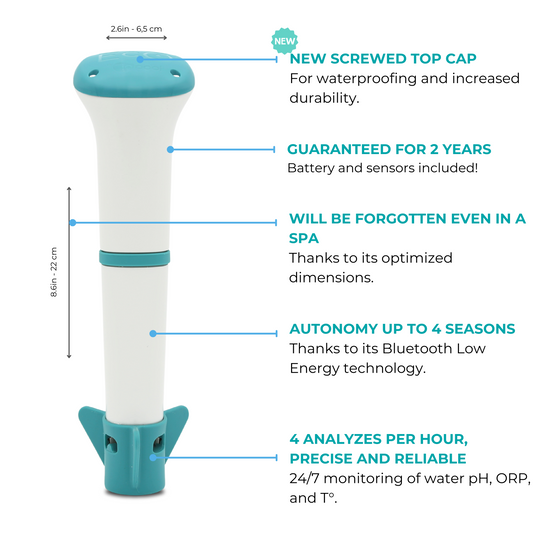
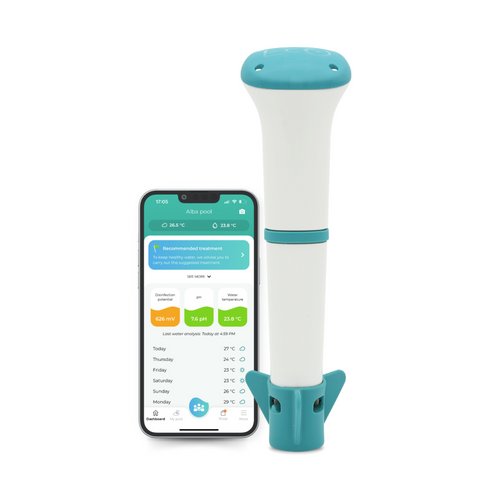
With a connected analyzer like the iopool EcO probe, you can monitor your pool's key parameters — pH, disinfection, temperature — directly from your smartphone, and get alerts before things get out of hand.
FAQ
What's the difference between pool stabilizer, cyanuric acid, and CYA?
--> They're all the same thing. Pool stabilizer is the common product name, cyanuric acid is the chemical name, and CYA is the standard abbreviation. All three refer to the same compound.
Can stabilizer levels drop on their own?
--> No. Stabilizer is chemically stable in water and doesn't degrade over time. The only way to lower it is to dilute the pool water.
Do I need to add stabilizer if I use stabilized chlorine tablets?
--> Usually not. Stabilized tablets already contain cyanuric acid. Adding extra stabilizer on top risks pushing your levels too high, especially over successive seasons.
What's the difference between stabilized and unstabilized chlorine?
--> Stabilized chlorine (tablets, sticks) already contains stabilizer (cyanuric acid). Unstabilized chlorine (shock, liquid chlorine) does not. For outdoor pools, stabilized products are the everyday standard. Chlorine shock is typically unstabilized and doesn't affect your stabilizer level.
Why does chlorine become ineffective when there's too much stabilizer?
--> Because stabilizer and chlorine form a molecular bond. At normal concentrations, this bond is reversible: chlorine is gradually released to disinfect the water. But when stabilizer exceeds 100 ppm, the bond becomes too strong. Chlorine stays "locked" and is no longer available to eliminate bacteria and algae — even if your tester shows a positive reading.
Can a high stabilizer level affect anything other than chlorine?
--> Stabilizer doesn't directly affect pH, alkalinity, or calcium hardness. Its impact is specifically on chlorine efficacy. But because it silently neutralizes disinfection, it can indirectly lead to bacterial and algae problems that then require other corrective treatments.