Pool pH Too High or Too Low: Causes, Effects and How to Fix It

Short answer: The ideal pool pH is between 7.2 and 7.4. Below 7.0, the water is corrosive and damages equipment. Above 7.6, chlorine loses most of its effectiveness and the water becomes irritating. In both cases, the fix follows the same protocol: test Total Alkalinity (TA) first, correct TA if needed, then adjust pH in small increments. This guide explains why pH drifts, what it does to your water, and how to fix it so it actually stays fixed.
Why pH Is the Most Important Water Parameter
pH determines how effective every other treatment is. Chlorine dosed correctly in water at pH 8.0 operates at less than 20% of its capacity. The same chlorine at pH 7.2 operates at over 60%. pH isn't just another parameter to track — it's the master variable that determines whether your water is actually sanitized.
| pH Value | Water Condition | Chlorine Effectiveness | Main Consequence |
|---|---|---|---|
| Below 6.8 | Very acidic | High (but chlorine unstable) | Rapid equipment corrosion, severe irritation |
| 6.8 – 7.2 | Slightly acidic | Good to very good | Possible irritation for sensitive swimmers |
| 7.2 – 7.4 | Ideal range | Optimal (60 to 75% active chlorine) | None: comfortable, well-sanitized water |
| 7.4 – 7.6 | Slightly alkaline | Reduced (40 to 55%) | Tolerable, but monitor closely |
| 7.6 – 8.0 | Alkaline | Low (20 to 35%) | Red eyes, scale deposits, cloudy water |
| Above 8.0 | Very alkaline | Near zero (below 20%) | Swimming not recommended, high bacterial risk |
pH Too High (Above 7.6)
Most Common Causes
| Cause | Mechanism | How Common |
|---|---|---|
| Total Alkalinity too high | Highly buffered water resists pH corrections and naturally drifts alkaline | Very common |
| Hard fill water | Water rich in calcium and magnesium is naturally alkaline | Common in hard water areas |
| Aeration and water movement | Jets, waterfalls, and swimming release CO2, which raises pH | Common in summer |
| Chemical additions | Granular chlorine (pH ~11), flocculants, and some algaecides raise pH | Common after treatment |
| Heat and evaporation | Evaporation concentrates minerals, increasing pH over time | Common during hot spells |
| New plaster or cement finish | Cement-based surfaces leach lime, causing pH to spike in new or renovated pools | New or recently replastered pools |
What High pH Does to Your Pool
- Chlorine becomes largely inactive: treatment is ineffective even at high doses
- Red eyes, itchy skin, dry feeling after swimming
- Cloudy or milky water from calcium precipitation
- White scale deposits on walls, the waterline, and equipment
- Algae growth (chlorine is no longer doing its job)
- Progressive filter clogging from scale buildup
- Increased chlorine consumption: you keep adding it without effect, which generates chloramines
How to Fix High pH
Step 1: Test Total Alkalinity before touching the pH. If TA is above 120 ppm, lowering pH will be pointless — it will drift back up within hours. Bring TA down first.
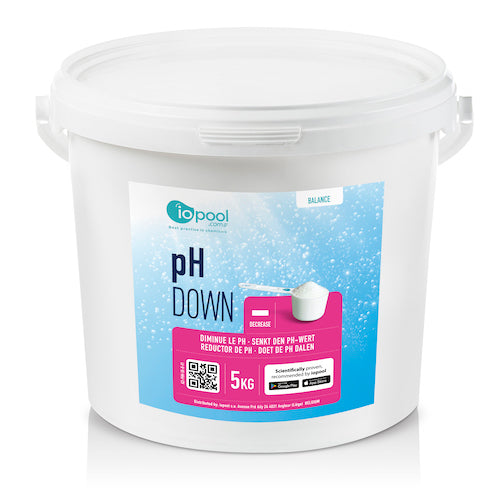
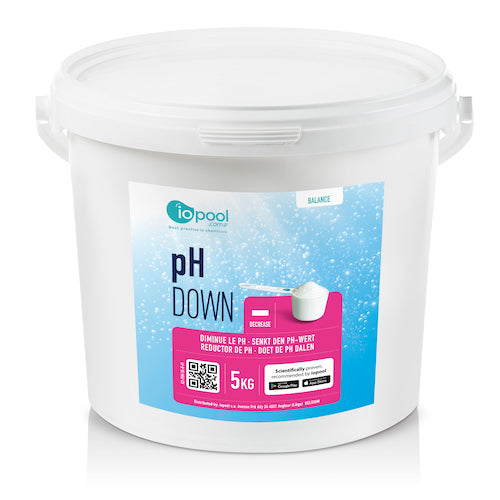
Step 2: Add pH decreaser in small doses.
- Product to use: sodium bisulfate (dry acid, powder) or muriatic acid (liquid)
- Pre-dilute in a bucket of water before pouring near the return jets with the pump running
- Never pour undiluted product directly into the pool
- Target a maximum correction of 0.2 pH points per addition
- Wait 4 to 6 hours with the filter running before retesting
- Avoid swimming for at least 12 hours after adding pH decreaser
Step 3: Retest and repeat if needed. If pH remains high after the first correction, add another small dose. Never try to correct a pH of 8.5 in a single addition — large swings destabilize other parameters.
If your pH keeps climbing back up after every correction despite regular additions of pH decreaser, the problem is almost certainly high Total Alkalinity, not a dosing issue. Fix the TA first: that's what's holding the pH up.
pH Too Low (Below 7.2)
Most Common Causes
| Cause | Mechanism | How Common |
|---|---|---|
| Total Alkalinity too low | Without sufficient buffering, pH drops quickly under the effect of acids | Very common |
| Rain | Rainwater has a pH below 7 and drives pool pH down | Common after storms |
| Overdosing pH decreaser | Adding too much acid when correcting high pH | Common for beginners |
| Liquid chlorine (sodium hypochlorite) | Liquid chlorine is acidic and gradually lowers pH with regular use | Common with liquid chlorine treatment |
| Naturally soft or acidic fill water | Some spring or collected rainwater has a naturally low pH | Region-dependent |
What Low pH Does to Your Pool
- Corrosive water that damages equipment: pump, filter, liner, metal fittings and ladders
- Liner and surface discoloration
- Burning and irritation of eyes, skin, and mucous membranes
- Unstable chlorine: degrades very rapidly, requiring frequent additions
- Mineral precipitation causing cloudy water
How to Fix Low pH
Step 1: Test Total Alkalinity. If TA is below 80 ppm, raise it first with baking soda (sodium bicarbonate). Low TA is the main driver of unstable pH and sudden drops.
Step 2: Add pH increaser in small doses.
- Product to use: sodium carbonate (soda ash) or sodium bicarbonate (baking soda)
- Pre-dilute in a bucket before pouring near the return jets with the pump running
- Target a maximum correction of 0.2 pH points per addition
- Wait 4 to 6 hours with the filter running before retesting
Why pH Won't Move No Matter What You Add
This is one of the most common questions on pool forums. You've added pH decreaser or increaser, waited several hours, and the reading is exactly where it was. The reason is almost always the same: Total Alkalinity is too high.
High TA creates what chemists call a "buffering effect": the water resists pH changes. The higher the TA, the more chemical you need to shift pH — and the faster it drifts back after each correction.
| Situation | Likely Cause | Fix |
|---|---|---|
| Added pH decreaser but pH won't drop | TA too high (above 120 ppm) | Lower TA first using muriatic acid or a larger dose of dry acid |
| Added pH increaser but pH won't rise | TA too low (below 80 ppm) | Raise TA with baking soda, then adjust pH |
| pH corrected but climbs back within 24 hours | TA too high or very hard fill water | Prioritize TA correction; consider a water softener if local water is very hard |
| pH swings widely from day to day | TA too low | Raise TA to 80–120 ppm to stabilize pH |
The Role of Total Alkalinity in pH Stability
Total Alkalinity (TA) is the concentration of carbonates and bicarbonates dissolved in the water. It determines the buffering capacity of the water — its resistance to pH swings.
| TA Level | pH Behavior | Recommended Action |
|---|---|---|
| Below 80 ppm | pH unstable, shifts rapidly and unpredictably | Add baking soda (sodium bicarbonate) to raise TA |
| 80 – 120 ppm | Ideal range: pH stable and easy to adjust | No TA adjustment needed |
| 120 – 200 ppm | pH resistant to correction, slow to respond | Lower TA with muriatic acid or dry acid |
| Above 200 ppm | pH almost impossible to correct durably | Partial drain and refill to dilute TA |
The correction order to follow without exception: Total Alkalinity → pH → Phosphates → Chlorine. Adjusting pH without checking TA first is the single most common mistake pool owners make.
Full Reference Table: pH and Related Parameters
| Parameter | Ideal Range | Product if Too Low | Product if Too High | Test Frequency |
|---|---|---|---|---|
| pH | 7.2 – 7.4 | pH increaser (soda ash) | pH decreaser (dry acid / muriatic acid) | 2 to 3 times per week |
| Total Alkalinity (TA) | 80 – 120 ppm | Baking soda (sodium bicarbonate) | Muriatic acid or dry acid | Once a month |
| Calcium Hardness (CH) | 200 – 400 ppm | Calcium chloride | Dilution or scale inhibitor | Once a month |
How to Keep pH Stable Long-Term
A pH that constantly drifts is almost always caused by unbalanced Total Alkalinity, very hard fill water, or chemicals added without checking their impact on pH first.
Good Habits to Adopt
- Test pH and chlorine two to three times a week during swimming season
- Test TA once a month and correct it before touching pH
- Always wait 4 to 6 hours after adding any chemical before retesting
- Never correct pH by more than 0.2 points per addition
- Test pH after every storm, heavy swim session, or shock treatment
- Pre-dilute all correctors in a bucket before adding them to the pool
Continuous Monitoring as a Preventive Solution
Most pH problems happen because the imbalance isn't caught early enough. A pH sitting at 7.8 for three days means three days of nearly inactive chlorine and three days of growing bacterial risk.
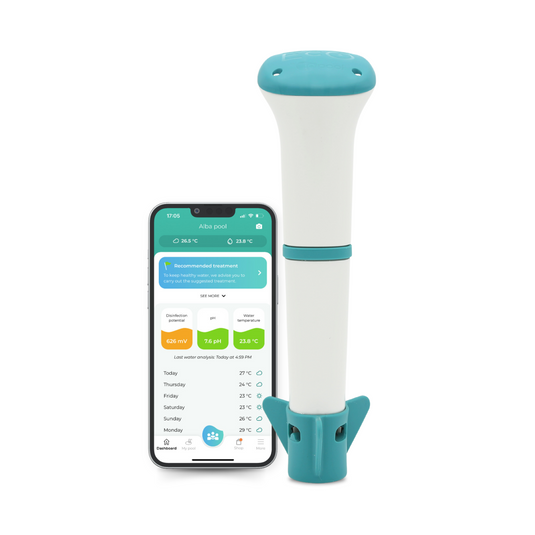
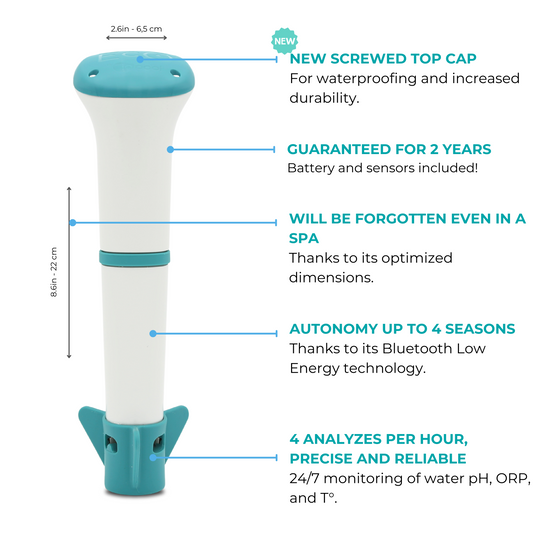
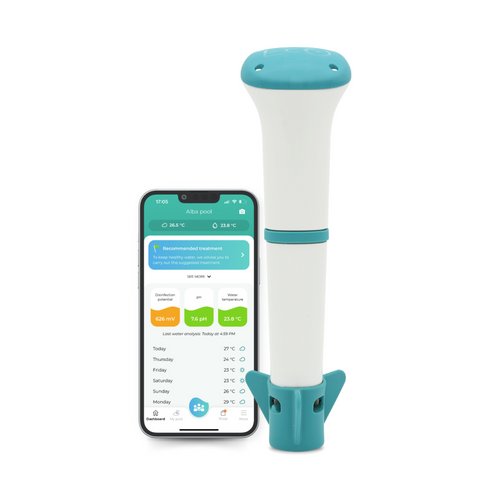
A connected pool analyzer like the iopool Eco Start measures pH every 15 minutes and sends you a smartphone alert the moment it drifts out of range — well before the consequences become visible. You correct a 0.1-point drift before it becomes a 0.8-point problem.
FAQ
What is the ideal pH for a pool?
The ideal pool pH is between 7.2 and 7.4. This range provides the best balance between sanitizer effectiveness, swimmer comfort, and equipment protection. A pH between 7.4 and 7.6 is tolerable but should be monitored. Below 7.0 or above 8.0, immediate action is needed.
Why does my pH keep rising after every correction?
The main cause is high Total Alkalinity. Buffered water resists pH corrections and naturally drifts alkaline. Test your TA: if it's above 120 ppm, lower it first with muriatic acid or dry acid before attempting any pH adjustment.
Can I use vinegar to lower pool pH?
Technically yes, but it's not practical. White vinegar is too dilute to have a meaningful effect on a pool volume, the dosing is imprecise, and it can introduce organic impurities that promote chloramine formation. Use a professional pH decreaser (dry acid or muriatic acid) instead: safer, more precise, and more cost-effective at scale.
How long should I wait after adding pH decreaser before swimming?
At least 12 hours — long enough for the product to distribute evenly throughout the pool and for filtration to homogenize the water. Retest pH before allowing swimming and confirm it has returned to between 7.2 and 7.4.
How do I lower pH without lowering Total Alkalinity?
It's difficult because the two parameters are chemically linked. Dry acid (sodium bisulfate) lowers both pH and TA simultaneously. Muriatic acid is more targeted for lowering TA specifically — but it requires careful handling (gloves, eye protection, slow addition). In either case, work in small doses and retest frequently.
My new pool has a very high pH — is that normal?
Yes, it's common. Cement-based finishes (plaster, pebble tec, marcite) leach lime during the first few weeks, naturally driving pH upward. Multiple corrections are often needed before pH stabilizes. Very hard fill water can compound the issue depending on your local water supply.
My pH is correct but the water is still cloudy — why?
Correct pH doesn't guarantee clear water. Cloudy water with balanced pH can signal TA or Calcium Hardness that's too high (calcium precipitation), high phosphate levels, insufficient filtration, or a need for flocculant. Test TA, CH, and phosphates before drawing conclusions.
Does a connected pool analyzer measure pH continuously?
Yes. The iopool Eco Start measures pH every 15 minutes and sends you an app recommendation the moment an adjustment is needed. This is especially useful after adding chemicals, after a storm, or after a heavy swim session — you get an alert before the imbalance has time to become a real problem.
Struggling to keep your pH stable despite regular corrections? Share your readings in the comments (current pH, TA, CH, treatment type, and pool volume) and our team will help you track down the cause.