High Alkalinity in Your Pool: Causes, Consequences and How to Fix It

In Brief
Total alkalinity (TA) measures the water's capacity to stabilize pH. The recommended range is 80–120 ppm. Above 150–180 ppm, a chain reaction sets in: pH rises and locks high, chlorine loses effectiveness, limescale deposits form, and the water turns cloudy. The fix is progressive doses of pH decreaser (pH–) added with the pump off, followed by retesting. Partial dilution works for very high levels. The problem is often avoidable with regular monitoring.
What Is Total Alkalinity?
Total alkalinity (TA) measures the concentration of carbonates and bicarbonates dissolved in water. Its main role is to act as a buffer for pH: it stabilizes the pH and prevents it from swinging sharply in response to chemical additions, rain or evaporation.
The recommended range for a pool is 80–120 ppm. Below that, water becomes unstable and potentially corrosive. Above it, the opposite problem occurs: pH rises, stiffens, and becomes very difficult to correct.
Why High Alkalinity Is a Problem
A TA above 150–180 ppm triggers a chain reaction that affects several parameters at once.
pH rises and locks high. Excess alkalinity pushes pH toward high values — often above 7.8 or even 8.0 — and makes it highly resistant to correction. You add pH decreaser, the pH drops slightly, then climbs back up. This is frustrating, time-consuming, and a common cause of overdosing.
Chlorine loses effectiveness. Chlorine's disinfecting action is directly tied to pH. Above 7.8, a growing proportion of chlorine shifts into an inactive form (hypochlorite) that no longer disinfects. At pH 8.0, it's estimated that over 70% of the chlorine present in the water is inactive. You can show a seemingly correct chlorine reading while the water is poorly disinfected.
Limescale deposits form. High pH combined with high alkalinity promotes calcium carbonate precipitation. The result: white or grey deposits on walls, jets, the pool floor, and inside the filter. These build-ups are difficult to remove and can eventually clog pipes or damage equipment.
Water turns cloudy. Calcium precipitation gives the water a milky or hazy appearance, even with chlorine present. Cloudy water makes it impossible to see the pool floor — a genuine safety concern.
Swimming becomes uncomfortable. An excessively high pH can cause skin and eye irritation for swimmers, even without excess chlorine.
What Causes High Alkalinity
Several factors can push TA above recommended levels:
- Hard tap water: in limestone-rich regions, tap water is naturally high in bicarbonates. Every top-up adds more TA.
- Overdosing alkalinity increaser: a past overcorrection with TA+ or sodium bicarbonate can send levels well above target.
- Certain treatment products: some chlorine shock products (dichlor-based) and some pH correctors can influence alkalinity over time.
- Evaporation: as water evaporates, dissolved salts and minerals concentrate, gradually raising TA over a season.
High Alkalinity: What to Do
Step-by-Step Correction with pH Decreaser
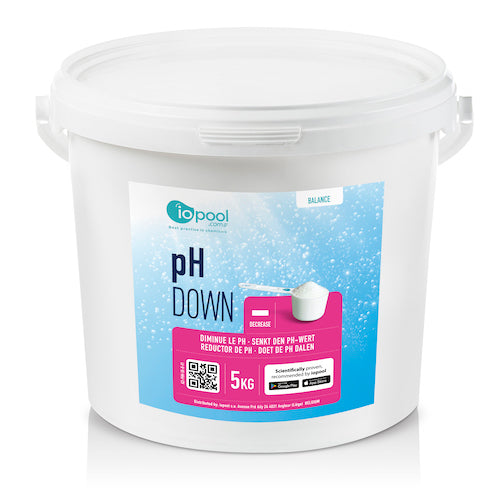
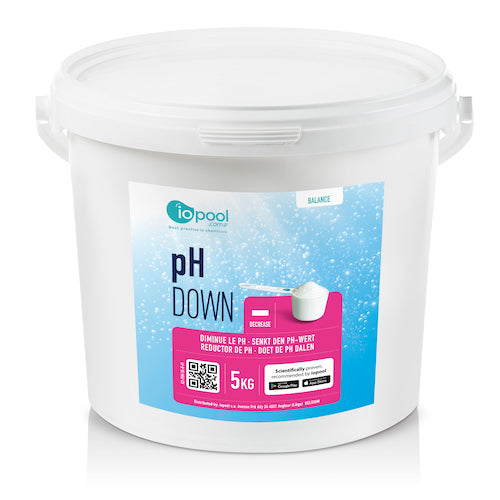
The main solution to reduce TA is adding a pH decreaser (pH–) — typically muriatic acid (diluted hydrochloric acid) or dry acid (sodium bisulfate). These products lower both pH and alkalinity.
1. Measure your TA precisely using a colorimetric test kit or test strips. Note the current value and your target (80–120 ppm).
2. Turn the circulation pump off. Adding pH– with the pump stopped creates localized concentration zones in the water, which targets alkalinity more specifically than pH alone.
3. Pour the pH– in a single spot — ideally the center or deepest part of the pool. Do not pre-dilute it in a bucket for this operation.
4. Wait 1–2 hours, then restart the pump to homogenize the water.
5. Retest TA and pH after 4–6 hours of circulation. Repeat if needed, working in incremental doses rather than adding everything at once.
Important: never add a large quantity of pH– in a single dose. Work in stages with checks between each addition. A very high TA may require several interventions spread over 24–48 hours.
Aeration: A Natural Complement
Aerating the water — running the pump with jets directed toward the surface, or activating a waterfall or fountain feature — helps degas carbon dioxide (CO₂) from the water. This degassing contributes to naturally raising pH while progressively lowering alkalinity. It's a gentle, complementary method, useful for stabilizing the water after a chemical correction.
Dilution
If TA is very high (above 200 ppm) and resistant to chemical correction, a partial drain followed by refilling with fresh water remains the most effective method to quickly dilute carbonate concentration.
What If Alkalinity Is Too Low?
Low alkalinity (below 80 ppm) is equally common, often caused by heavy rainfall, a partial drain, or naturally soft fill water.
Insufficient alkalinity makes pH unstable and unpredictable. The water can also become corrosive, attacking walls, seals, plumbing and metal equipment. Swimmers may experience eye and skin irritation.
The fix is straightforward: add an alkalinity increaser (TA+, Alka+, or sodium bicarbonate). Dissolve it in a bucket of warm water before distributing it around the pool with the pump running, spreading it at multiple points for even dissolution. Retest after a few hours of circulation.
Heavy rain is one of the most frequent causes of alkalinity drops. Always test the water after a significant rainfall.
Reference Values
| Parameter | Ideal Range | Too Low | Too High |
|---|---|---|---|
| Total Alkalinity (TA) | 80–120 ppm | < 80 ppm: volatile pH, corrosive water | > 150 ppm: locked pH, limescale, ineffective chlorine |
FAQ
Why does pH keep rising even after I add pH decreaser? This is the classic symptom of high alkalinity. The buffering capacity of the water is so strong that it continuously pushes pH back up after each correction. The solution isn't to add more pH–, but to specifically target alkalinity first — using the pump-off technique — before stabilizing pH.
Can I lower alkalinity without affecting pH? Not completely, but the pump-off method (adding pH– in a concentrated spot without circulating) preferentially targets alkalinity over pH. Aeration afterward then raises pH back up naturally without affecting TA. This combined approach lets you work on the two parameters somewhat independently.
How long does it take to bring high alkalinity back to normal? It depends on the starting level. For a TA between 150 and 200 ppm, two to three correction sessions over 24–48 hours are usually enough. Above 200 ppm, partial dilution is often the more practical and faster route.
Does hard tap water cause alkalinity to rise? Yes. In hard-water areas, tap water is naturally rich in bicarbonates. Every refill — whether for topping up evaporation or after a partial drain — introduces additional TA. In these regions, checking TA at pool opening and mid-season is particularly important.
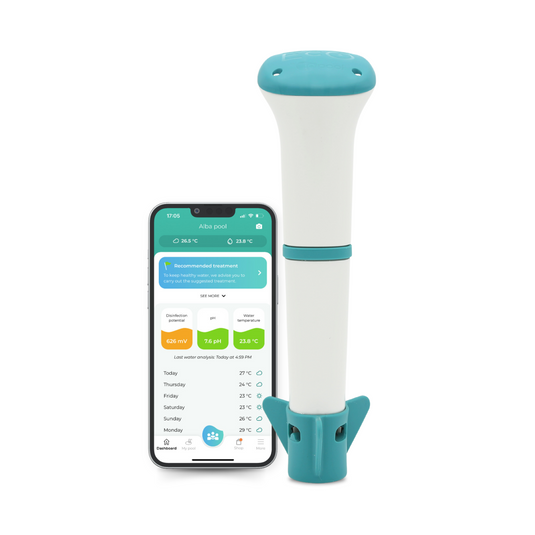
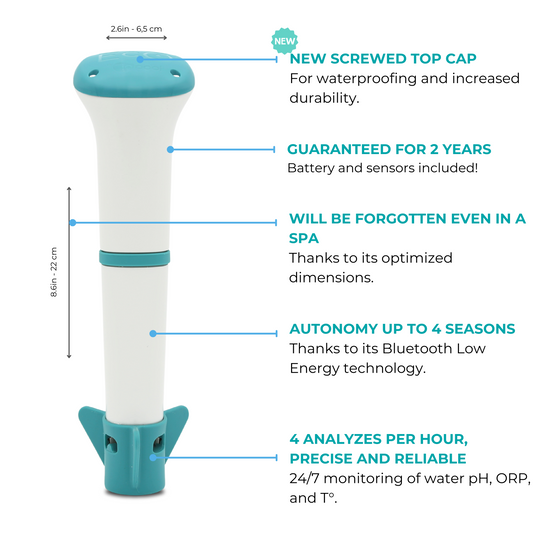
With a connected analyzer like iopool's EcO probe, can I monitor alkalinity automatically? The EcO probe continuously measures pH, ORP and temperature. TA isn't measured electronically in real time — it requires a manual test. However, iopool's recommendations factor in pH trends to flag when an alkalinity issue is likely contributing to instability, helping you diagnose and act faster.