Pool Chlorine Levels: What They Should Be and Why They Keep Changing

Short answer: The ideal free chlorine level in a pool is between 1 and 3 ppm. But that number alone tells you very little — chlorine at 2 ppm can be completely inactive if your pH is above 7.6 or your CYA (stabilizer) is above 75 ppm. This guide covers target values by treatment type, why chlorine levels fluctuate, how to fix them, and why measuring ORP gives you a more reliable picture of your water's actual sanitation than a chlorine test alone.
Free Chlorine, Combined Chlorine, Total Chlorine: What's the Difference?
Before talking about target numbers, it helps to understand what you're actually measuring. Three forms of chlorine coexist in pool water, and they don't all do the same job.
| Type | What it is | Role in the water | Target level |
|---|---|---|---|
| Free Chlorine (FC) | Available, active chlorine | Sanitizes the water — kills bacteria, algae, and viruses | 1 – 3 ppm |
| Combined Chlorine (CC) (chloramines) | Chlorine that has already reacted with organic matter (sweat, urine, sunscreen) | Inactive as a sanitizer, irritating, responsible for the "pool smell" | Below 0.6 ppm |
| Total Chlorine (TC) | Sum of free chlorine and combined chlorine | Overall indicator, not meaningful on its own | FC + CC |
The key point: free chlorine is what sanitizes your water. That strong pool smell and burning eyes after a swim almost always signal too many chloramines, not too much free chlorine. The wider the gap between total chlorine and free chlorine, the more chloramines are present and the more urgently a shock treatment is needed.
Target Values by Treatment Type
The right free chlorine target depends on whether your water contains cyanuric acid (CYA/stabilizer). CYA reduces the effectiveness of active chlorine, which means stabilized pools need a higher chlorine level to achieve the same sanitation result.
| Treatment type | Free chlorine target | Max combined chlorine | Recommended pH |
|---|---|---|---|
| Unstabilized chlorine (liquid chlorine, cal-hypo) | 0.4 – 1.4 ppm | Below 0.6 ppm | 7.2 – 7.4 |
| Stabilized chlorine (trichlor tablets, dichlor granules) | 2 – 3 ppm | Below 0.6 ppm | 7.2 – 7.5 |
| Saltwater pool (salt chlorine generator) | 0.5 – 1.5 ppm | Below 0.6 ppm | 7.2 – 7.4 |
| Shock treatment (curative) | 5 – 10 ppm for 24 to 48 hours | Not applicable | 7.2 – 7.4 (correct before shocking) |
Reference standard: the CDC and the Association of Pool and Spa Professionals (APSP) recommend a minimum free chlorine level of 1 ppm for residential pools with CYA present, and 2 ppm for pools using stabilized chlorine. These guidelines are the technical benchmark used by pool professionals in the US and UK.
Chlorine within the target range does not guarantee a well-sanitized pool. Chlorine at 2 ppm with a pH of 8.0 is operating at less than 20% of its potential. Chlorine measures quantity, not effectiveness.
Why Do Chlorine Levels Keep Changing?
Chlorine is inherently unstable — it degrades continuously in pool water. Several factors accelerate or slow that degradation.
| Factor | Effect on chlorine | Recommended action |
|---|---|---|
| UV radiation (sunlight) | Rapidly degrades unstabilized chlorine (up to 50% loss per hour in full sun) | Keep CYA between 30 and 50 ppm to protect chlorine from UV |
| High water temperature (>82°F) | Accelerates chlorine degradation and bacterial growth | Increase testing and dosing frequency |
| Heavy bather load | Organic matter (sweat, sunscreen) rapidly consumes free chlorine | Preventive shock treatment after every heavy swim session |
| Rain or storms | Dilutes chlorine and introduces phosphates and organic contaminants | Test and readjust within 24 hours after rain |
| pH above 7.6 | Neutralizes chlorine without destroying it (present but inactive) | Correct pH before adding any chlorine |
| CYA above 75 ppm | Locks up active chlorine despite a normal-looking reading | Partial drain and refill — the only effective solution |
| Insufficient filtration | Stagnant zones where chlorine doesn't reach algae | Apply the rule: water temp (°F) ÷ 2 = daily filter hours |
Chlorine Too Low: Causes and Fixes
Free chlorine below 0.5 ppm is insufficient to sanitize the water effectively. Swimming is not recommended, and algae can develop rapidly — especially in warm weather.
Most Common Causes
- Missed or underdosed chlorine addition
- High heat combined with heavy use
- pH too high, neutralizing the chlorine already present
- CYA too high, locking up active chlorine
- High phosphate levels driving accelerated chlorine consumption by algae
How to Fix It
- Test pH before adding any chlorine — adding more chlorine to unbalanced water is pointless
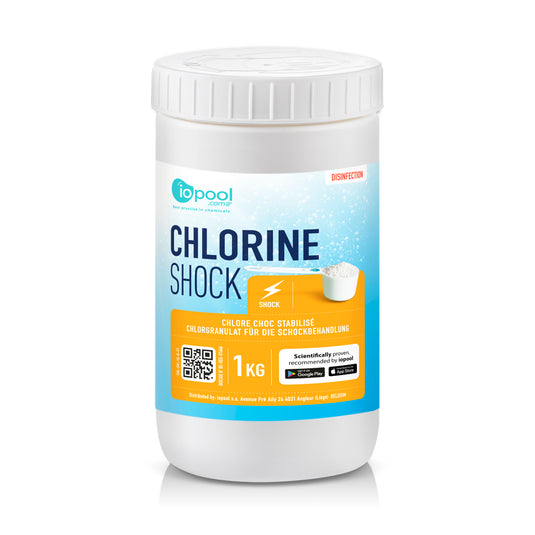
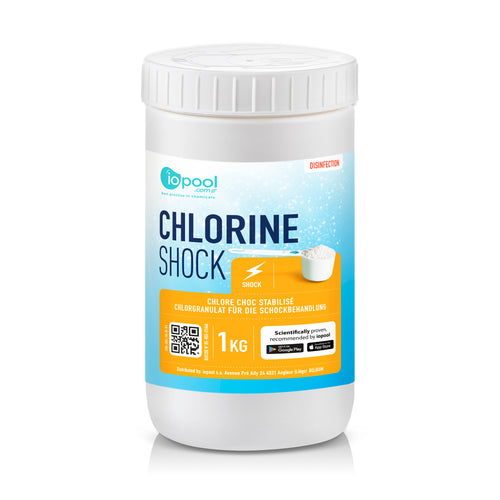
- If pH is correct (7.2 – 7.4), shock with unstabilized chlorine (calcium hypochlorite or liquid chlorine)
- If CYA is above 75 ppm, drain and refill 30–50% of the pool before treating
- Run the filter continuously for 24 to 48 hours after shocking
Chlorine Too High: Causes and Fixes
Free chlorine above 5 ppm causes eye and skin irritation. Swimming is not recommended until levels return to normal.
| Free Chlorine Level | Situation | Recommendation |
|---|---|---|
| 1 – 3 ppm | Ideal range | No action needed |
| 3 – 5 ppm | Slightly elevated | Allow natural degradation, avoid prolonged swimming |
| 5 – 10 ppm | Shock treatment in progress | No swimming, retest after 24 hours |
| Above 10 ppm | Overdose | Do not swim, run filter, expose water to sunlight to accelerate degradation |
How to Fix a Chlorine Overdose
- Stop all chlorine additions immediately
- Run the filter and let sunlight naturally degrade the chlorine — UV breaks down free chlorine without any chemical intervention
- Avoid chlorine neutralizers unless absolutely necessary: they often throw off other parameters
- Retest every 12 hours until levels drop below 3 ppm
Why ORP Is More Reliable Than Chlorine Alone
A chlorine test measures quantity. ORP (Oxidation-Reduction Potential) measures effectiveness. That's the fundamental difference — and it explains why two pools with identical chlorine readings can have radically different levels of actual sanitation.
| Free Chlorine measurement | ORP measurement | |
|---|---|---|
| What it measures | How much chlorine is present in the water | How effectively the water can destroy pathogens |
| pH influence | Not accounted for: chlorine at 2 ppm with pH 8.0 looks fine | Accounted for: high pH produces a low ORP even with correct chlorine |
| CYA influence | Not accounted for: chlorine locked by CYA still shows a normal reading | Accounted for: neutralized chlorine produces a low ORP |
| Target value | 1 – 3 ppm (varies by treatment type) | 650 – 750 mV (universal, independent of treatment type) |
| Measurement tool | Test strips, DPD1 photometer | Connected analyzer (redox probe) |
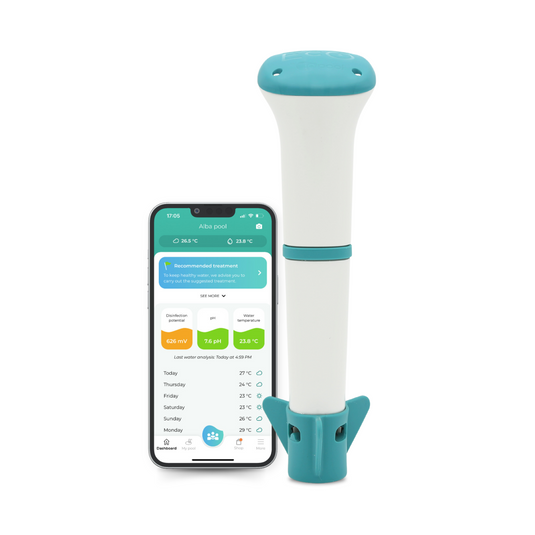
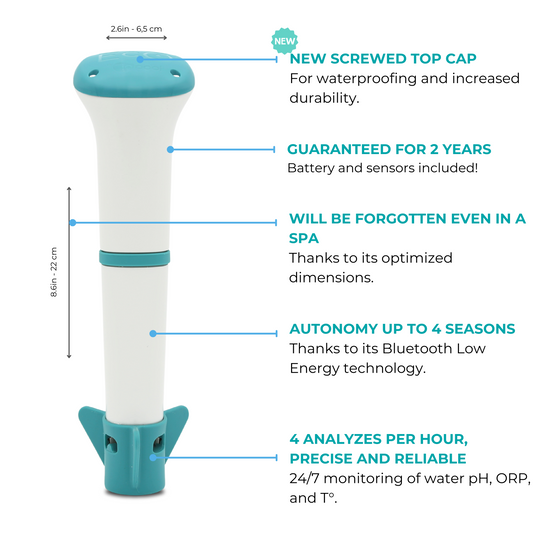
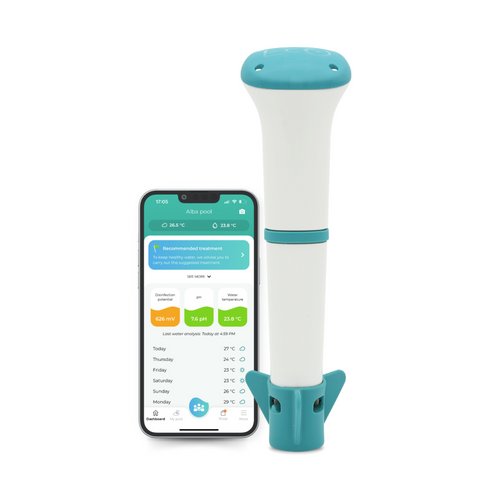
An ORP above 650 mV indicates the water is effectively sanitized, regardless of whether you use chlorine, saltwater, or bromine. This is the standard used in commercial and Olympic pools worldwide, and it's what the iopool Eco Start measures continuously.
How to Measure Chlorine Accurately
| Method | What it measures | Accuracy | Limitations |
|---|---|---|---|
| Colorimetric test strips | Free chlorine (sometimes total chlorine) | Low to moderate | Subjective color reading, light-sensitive, high margin of error |
| Drop test kit (DPD1/DPD3) | Free chlorine (DPD1) and total chlorine (DPD3) | Good | More involved process, results still somewhat subjective |
| Digital photometer | Free and total chlorine with precision | Very good | Higher cost, requires regular cell maintenance |
| Connected analyzer (ORP measurement) | ORP continuously (indirect indicator of chlorine effectiveness) | Excellent for overall sanitation | Does not give a direct ppm chlorine reading |
Practical recommendation: combining a weekly free chlorine test with a photometer (to know the quantity) with continuous ORP monitoring via a connected analyzer (to know the actual effectiveness) gives the most complete picture of your water quality.
FAQ
What is the ideal chlorine level for a pool?
For pools using stabilized chlorine (trichlor tablets or dichlor), the ideal free chlorine range is 2 to 3 ppm. For unstabilized chlorine (liquid chlorine, calcium hypochlorite), it's 0.4 to 1.4 ppm. For saltwater pools, 0.5 to 1.5 ppm. In all cases, these numbers are only meaningful if pH is between 7.2 and 7.4.
My chlorine level is fine but my pool is still green — why?
Two likely causes: either your pH is above 7.6 and has neutralized the chlorine (present but inactive), or your CYA is above 75 ppm and is blocking it. In both cases, adding more chlorine will have no effect. Start by testing pH and CYA before any treatment.
What's the difference between free chlorine and total chlorine?
Free chlorine is the active fraction that sanitizes your water. Total chlorine includes free chlorine plus combined chlorine (chloramines), which is inactive and irritating. If your total chlorine reading is significantly higher than your free chlorine, chloramines are present and a shock treatment is needed.
Is it safe to swim if chlorine is at zero?
No. Without detectable free chlorine, the water is no longer sanitizing. Bacteria can develop without any visible change to the water's appearance. Add chlorine and wait at least an hour for levels to stabilize before swimming.
Why does my chlorine level drop so fast?
The most common causes are intense heat and sunlight (which degrade unstabilized chlorine rapidly), heavy bather load (organic matter consumes free chlorine), pH too high (which neutralizes chlorine without destroying it), or insufficient filtration. Check these parameters before simply adding more chlorine.
How often should I test my pool's chlorine level?
During peak summer season, two to three times a week at minimum. After a storm, a heavy swim session, or a heatwave, test immediately. A connected analyzer like the iopool Eco Start monitors ORP continuously, detecting imbalances without requiring daily manual testing.
Is chlorine level the only parameter I need to track?
No. pH conditions chlorine effectiveness, Total Alkalinity stabilizes pH, CYA affects how long chlorine lasts, and phosphates fuel algae growth. Correctly dosed chlorine in water that's off on any one of these parameters can be completely ineffective. A full water analysis (pH, TA, CYA, phosphates) once a month is essential alongside your weekly chlorine checks.
Are ppm and mg/l the same thing for pool chlorine?
Yes. For pool water, ppm (parts per million) and mg/l (milligrams per liter) are equivalent units: 1 ppm = 1 mg/l. You can use them interchangeably depending on the source or testing equipment you're using.
Struggling to keep your chlorine level stable despite regular additions? Share your readings in the comments (pH, CYA, treatment type, pool volume) and our team will help you identify the cause.